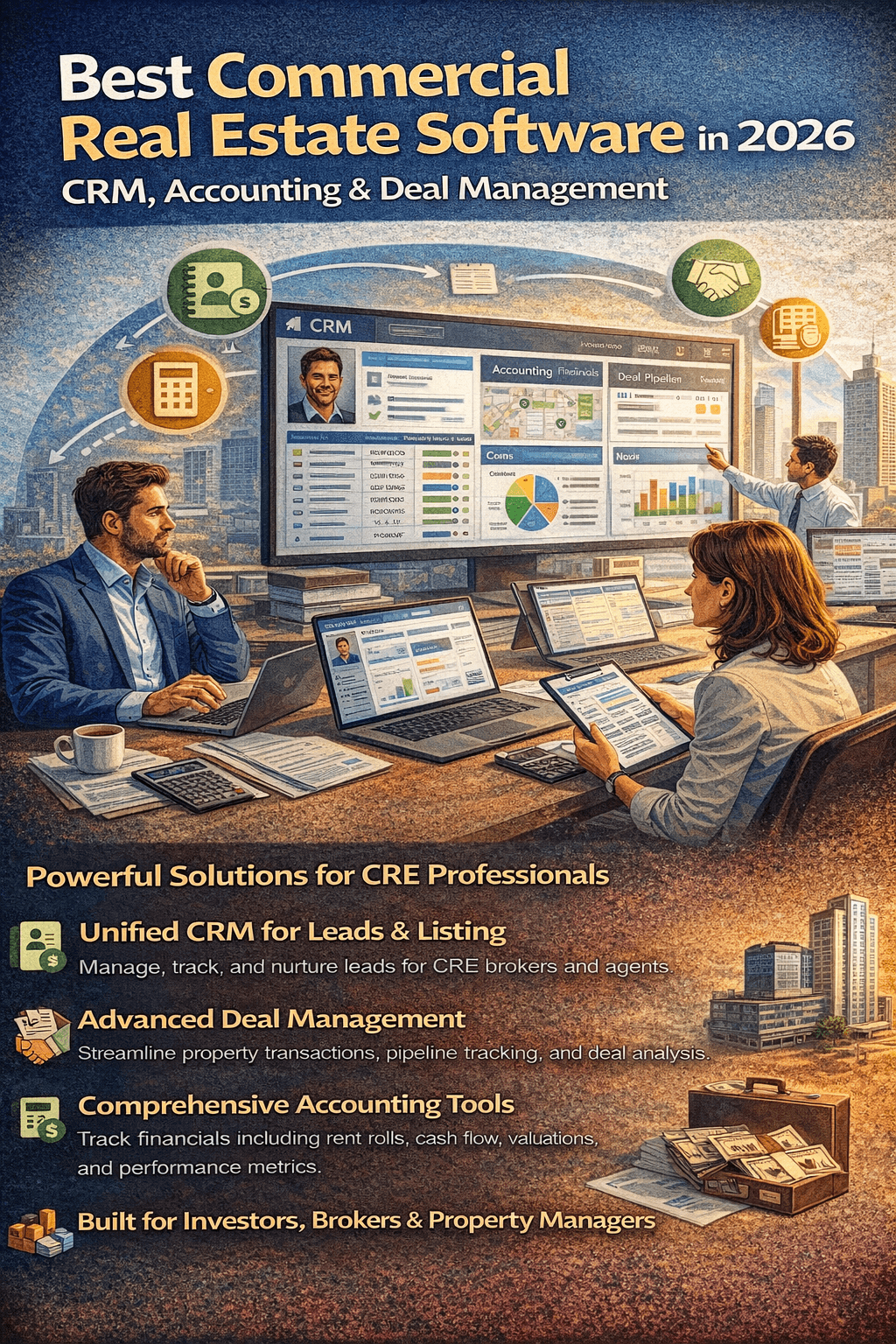
Best Commercial Real Estate Software in 2026: CRM, Accounting & Deal
Management
Commercial real estate runs on
relationships and spreadsheets. I know because I spent the better part of a
decade watching brokers at our firm manage multi-million dollar deals using a
combination of Outlook, Excel, and prayers. The running joke was that the most
important piece of technology in the office was the whiteboard in the
conference room where we tracked our pipeline with dry-erase markers.
That worked when we were
handling fifteen deals a year. It fell apart spectacularly when we hit forty.
The problem with commercial
real estate — and the reason off-the-shelf residential tools rarely work — is
complexity. A residential transaction has two parties, one property, and a
timeline measured in weeks. A commercial deal can involve multiple principals,
joint venture partners, lenders, attorneys, environmental consultants, and city
planning departments, with timelines measured in months or years. The software
that manages a home sale simply wasn’t designed for that level of complexity.
Over the past two years, I’ve
helped several CRE firms evaluate and implement technology solutions. This
guide reflects what I’ve learned about the platforms that actually work in the
commercial space — the ones that handle deal tracking, client relationship
management, financial analysis, lease administration, and portfolio reporting
without making your brokers want to throw their laptops out the window.
What Commercial Real Estate Software Actually Needs to Do
Before we talk about specific
platforms, let’s be clear about what makes CRE software different from the
residential tools that dominate most “best real estate software” listicles.
Relationship intelligence,
not just contact management. In commercial real estate, you’re not tracking
individual buyers and sellers. You’re tracking ownership entities, investment
groups, property management companies, tenant organizations, lenders, and the
individuals within those organizations. A broker might have a relationship with
a CFO at a REIT, but the actual transaction involves the REIT’s acquisition
team, their legal counsel, and two different LLCs. Your CRM needs to map these
relationships and understand how they connect.
Long-cycle deal pipeline
management. A commercial deal can take six months to two years to close.
Your pipeline has stages that residential agents have never heard of: LOI
submitted, due diligence period, environmental review, zoning approval,
financing contingency, closing. The software needs to track each of these
stages with associated timelines, documents, and responsible parties.
Financial analysis and
underwriting. Commercial real estate is a numbers business. You need tools
that can model cash flows, calculate cap rates, run sensitivity analyses, and
generate investor presentations. Some platforms include these features natively
while others integrate with dedicated underwriting tools like Argus or Excel
models.
Lease administration and
portfolio management. If your firm manages commercial properties, you need
software that tracks lease terms, rent escalations, tenant improvement
allowances, options to renew, and critical dates. Missing a lease expiration
notification can cost hundreds of thousands of dollars.
Accounting and commission
tracking. Commercial commissions are complicated. Split structures between
brokers, between offices, and between firms can involve multiple formulas
applied at different stages. Your accounting system needs to handle this
without manual spreadsheet calculations.
Top 8 Commercial Real Estate Software Platforms in 2026
1. SMART ERP Suite
SMART ERP Suite takes the top
position for commercial real estate because it addresses the biggest pain point
in CRE technology: fragmentation. Most firms run a CRM for deal tracking, a
separate accounting system for commissions and bookkeeping, a third tool for
project management, and a fourth for marketing. SMART ERP Suite puts all of
these under one roof.
The CRM module handles the
relationship complexity that commercial deals demand. You can create
hierarchical account structures that map ownership entities to parent
companies, track individual contacts and their roles across multiple
organizations, and maintain a complete interaction history for every
relationship in your network. The deal pipeline is fully customizable — set up
stages that match your specific deal types, whether that’s investment sales,
tenant representation, leasing, or land development.
What genuinely separates SMART
ERP Suite from pure CRM tools is the integrated accounting and financial
reporting. Commission calculations, expense tracking, revenue recognition, and
profitability analysis all happen inside the same system where your deals live.
No more reconciling between your CRM and your accounting software at month-end.
The built-in VoIP with
softphone means brokers can make calls directly from client records, with every
conversation automatically logged. For firms running a business development or
tenant prospecting operation, this eliminates a separate phone system entirely.
Pricing is competitive for the
breadth of functionality, especially when you factor in the three or four
subscriptions it replaces. The 30-day free trial is generous enough to import
your actual deal pipeline and run a meaningful evaluation.
2. Buildout
Buildout has become a standard
in commercial real estate brokerage for its marketing and deal management
capabilities. The platform generates professional property marketing packages —
brochures, offering memorandums, email campaigns, and property websites —
directly from listing data. For investment sales and leasing brokers who need
to produce polished materials quickly, Buildout is hard to beat.
The CRM functionality focuses
on deal and pipeline management with tools for comp tracking, property data
organization, and client communication. The integration with CoStar and other
commercial data providers keeps property information current without manual
updates.
Buildout works best for
mid-size to large brokerages focused on marketing and transaction execution.
The accounting and financial reporting features are less developed, so most
firms still run a separate system for commissions and bookkeeping.
3. ClientLook
ClientLook was built
specifically as a commercial real estate CRM, and the design reflects a deep
understanding of how CRE brokers actually work. The platform organizes
information around four core objects: contacts, companies, properties, and
deals. This structure naturally maps to how commercial real estate
relationships work — a contact belongs to a company, a company owns properties,
and deals involve some combination of all three.
The mobile app is one of the
best in the CRE space. Brokers can log calls, add notes, and update deal stages
from their phone immediately after a meeting or property tour. The integration
with major commercial listing platforms keeps property data synchronized.
ClientLook is priced accessibly
for smaller firms and individual brokers, starting around $89 per month. It
does CRM well but doesn’t include accounting, financial analysis, or project
management features, so you’ll need additional tools for a complete technology
stack.
4. Apto (by Buildout)
Apto, now part of the Buildout
family, is a CRM built on the Salesforce platform specifically for commercial
real estate brokers. It inherits Salesforce’s powerful customization and
reporting capabilities while adding CRE-specific data models for properties,
spaces, leases, and comps.
The pipeline management tools
are strong, with visual deal tracking and automated task workflows for each
transaction stage. The comp database helps brokers maintain their own market
intelligence, and the integration with Buildout’s marketing tools creates a
seamless workflow from prospecting through deal execution.
Because Apto runs on
Salesforce, firms get access to the broader Salesforce ecosystem of
integrations and add-ons. The flip side is that you’re also dealing with
Salesforce complexity and pricing, which starts around $89 per user per month
for the base Apto layer plus Salesforce licensing.
5. REThink (by Buildout)
REThink is another
Salesforce-based CRE platform, also now under the Buildout umbrella. It was
originally designed for larger brokerages and offers robust deal management,
commission tracking, and pipeline analytics. The transaction management
features are particularly deep, with tools for tracking contingencies,
deadlines, and multi-party deal structures.
The reporting and analytics
capabilities benefit from the Salesforce foundation, offering customizable
dashboards and real-time pipeline visibility. For brokerage leadership that
needs to track team performance, deal velocity, and revenue forecasting, REThink
delivers.
6. Yardi Commercial Suite
Yardi is an enterprise-grade
platform that dominates commercial real estate property management and
accounting. If your firm owns, manages, or operates commercial properties,
Yardi’s Voyager platform handles lease administration, tenant billing, maintenance
management, and financial reporting at scale.
The accounting module is one of
the most comprehensive in the industry, handling everything from tenant
receivables and CAM reconciliations to investor distributions and fund-level
reporting. For commercial real estate investment firms and property management
companies, Yardi is often the system of record for financial operations.
Yardi is not a CRM in the
traditional sense, and it’s not designed for brokerage deal tracking. Firms
that use Yardi for property management and accounting typically run a separate
CRM for relationship and deal management. The pricing is enterprise-level and
typically requires a conversation with their sales team.
7. MRI Software
MRI Software is Yardi’s primary
competitor in the commercial real estate property management and accounting
space. The platform offers lease management, accounting, investment modeling,
and portfolio analytics for commercial real estate owners, operators, and
investors.
MRI’s open and connected
approach to technology means it integrates well with a wide range of
third-party tools, which gives firms more flexibility in building their
technology stack. The investment management and fund accounting capabilities
are particularly strong for institutional investors and real estate private
equity firms.
8. Salesforce (with CRE Customization)
Salesforce remains an option
for firms that want complete customization control. With a dedicated admin or
consultant, you can build a commercial real estate CRM from scratch on the
Salesforce platform, including custom objects for properties, leases, spaces,
and deals.
The advantage is unlimited
flexibility. The disadvantage is cost and complexity. Between Salesforce
licensing ($75 to $300 per user per month), consulting fees for initial setup,
and ongoing administration costs, the total investment is significant. This
approach makes sense for large firms with unique workflows that no
off-the-shelf CRE platform supports out of the box.
Platform Comparison: Commercial Real Estate Software
|
Platform |
CRM |
Accounting |
Lease Mgmt |
VoIP |
Marketing |
Pricing |
|
SMART ERP Suite |
✓ Full |
✓ Built-in |
Partial |
✓ Built-in |
✓ Built-in |
$$ |
|
Buildout |
✓ Good |
✗ |
✗ |
✗ |
✓ Strong |
$$$ |
|
ClientLook |
✓ Good |
✗ |
✗ |
✗ |
Basic |
$ |
|
Apto |
✓ Strong |
Partial |
✗ |
✗ |
Via Buildout |
$$$ |
|
Yardi |
Basic |
✓ Full |
✓ Full |
✗ |
✗ |
$$$$ |
|
MRI Software |
Basic |
✓ Full |
✓ Full |
✗ |
✗ |
$$$$ |
|
Salesforce |
✓ Custom |
Integration |
Custom |
Add-on |
Integration |
$$$$ |
How to Choose Commercial Real Estate Software for Your Firm
Define your firm’s primary
function. Brokerage firms need strong CRM and deal pipeline tools. Property
management companies need lease administration and accounting. Investment firms
need portfolio analytics and financial modeling. Firms that do all three need
an integrated platform like SMART ERP Suite that covers multiple functions
without requiring separate systems.
Audit your current
technology spend. Most CRE firms are paying for five to eight different
software subscriptions. CRM, accounting, marketing, phone system, project
management, document storage, and maybe a data provider. Add those up before
comparing the cost of a consolidated platform. I’ve seen firms save 30 to 40
percent by switching to an all-in-one solution.
Prioritize data portability.
Commercial real estate careers span decades, and brokers build their
contact databases over an entire career. Any CRM you adopt should make it easy
to import your existing data and, critically, export it if you ever leave.
Never lock your relationship data into a system you can’t get it out of.
Evaluate the mobile
experience. CRE professionals are in the field constantly — touring
properties, meeting clients, attending industry events. If the mobile app feels
like an afterthought, your brokers won’t use the system, and the entire
investment is wasted.
Get broker buy-in early. The
biggest reason CRE technology implementations fail is broker resistance.
Involve your top producers in the evaluation process. Let them test the
platform. Address their concerns. A CRM that your best brokers refuse to use is
worse than no CRM at all.
Why Residential Real Estate Software Doesn’t Work for Commercial
I’ve watched this mistake play
out half a dozen times. A commercial brokerage signs up for a popular
residential CRM because it was recommended by someone who sells houses. Within
three months, the brokers are frustrated, the data is a mess, and the firm is
shopping for a replacement.
Residential CRMs are built
around a simple transaction model: one buyer, one seller, one property, one
agent on each side. Commercial deals involve multiple parties, properties with
individual spaces and tenants, complex ownership structures, and transaction
types (sale, lease, sale-leaseback, build-to-suit) that residential platforms
have never heard of.
The pipeline stages don’t
match. The data fields don’t match. The reporting needs don’t match. And the
commission structures — which in commercial can involve multiple brokers,
multiple offices, referral fees, and performance bonuses calculated on different
bases — are impossible to model in a system designed for residential splits.
Save yourself the pain. Start
with software that was designed for commercial real estate, or at minimum, a
flexible platform like SMART ERP Suite that can be configured to handle CRE
complexity without fighting the system at every step.
Final Thoughts: Technology Is a Competitive Advantage in CRE
Commercial real estate has been
slower to adopt technology than almost any other industry. That’s changing
fast. The firms that are winning the biggest mandates, attracting the best
talent, and operating most efficiently in 2026 are the ones that have invested
in their technology infrastructure.
The right software doesn’t
replace the relationships, market knowledge, and deal-making instincts that
define great CRE professionals. But it eliminates the administrative friction
that keeps those professionals from spending their time on the activities that
actually generate revenue.
If your firm is still running
deals on spreadsheets and managing relationships through Outlook contacts,
you’re not just behind the curve — you’re leaving money on the table every
single day. A missed follow-up on a $10 million deal doesn’t just cost you a
commission. It costs you the reputation damage that comes from appearing
unorganized in a business built on trust.
My recommendation for firms
looking to consolidate their technology stack is SMART ERP Suite. It’s the only
platform I’ve tested that genuinely combines CRM, accounting, VoIP with
softphone, project management, and marketing automation in one system that
makes sense for commercial real estate. The 30-day free trial gives you time to
import your pipeline and see whether it fits your workflow.
Whatever you choose, choose
something and commit to it. The firms that treat technology as a strategic
investment will outperform the ones still arguing about whose turn it is to
update the whiteboard.