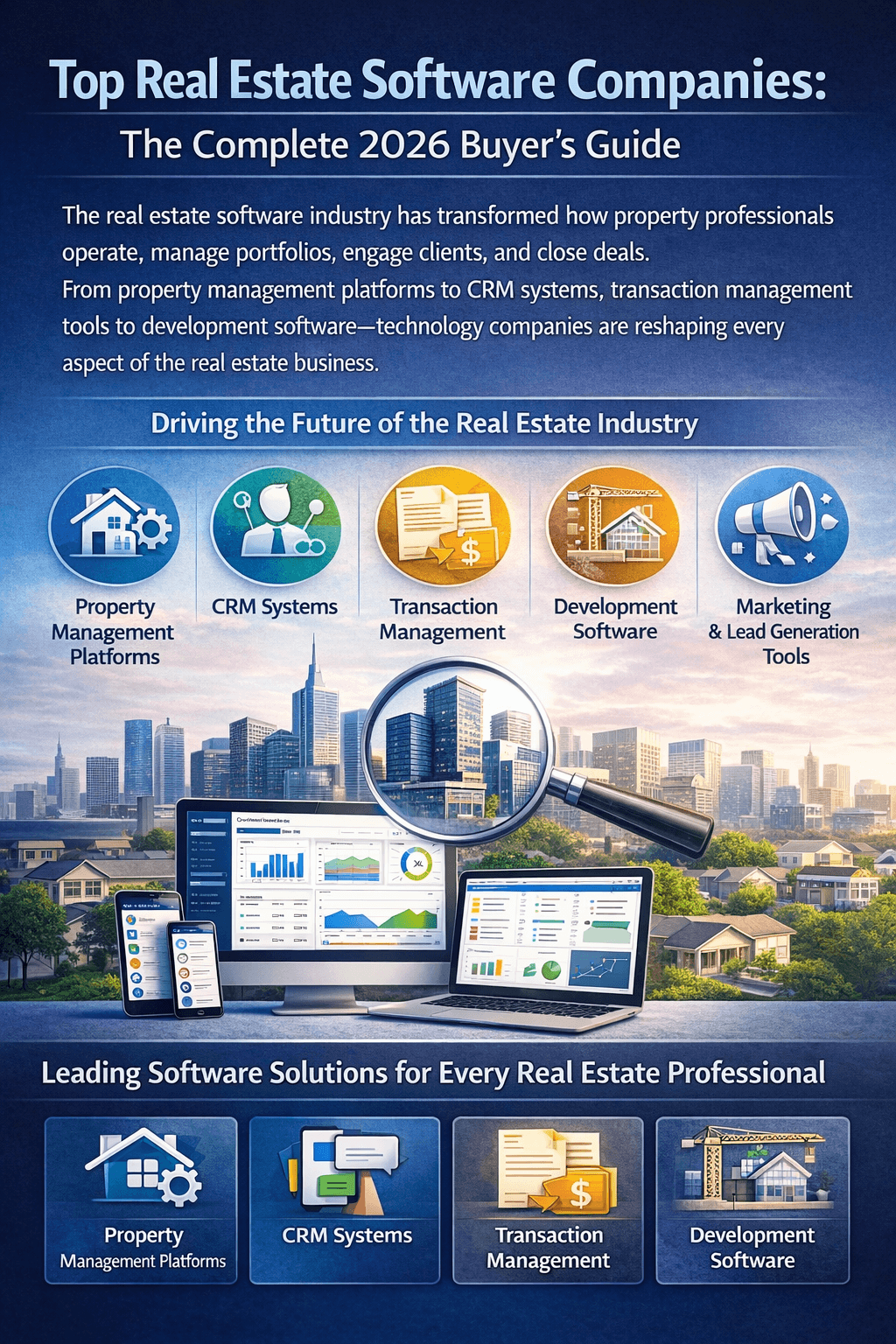
Top Real Estate Software Companies: The Complete 2026 Buyer's Guide
The real estate software industry has transformed how property professionals operate, manage portfolios, engage clients, and close deals. From property management platforms to CRM systems, transaction management tools to development software—technology companies are reshaping every aspect of the real estate business.
Selecting the right real estate software company as your technology partner is one of the most critical decisions you'll make. The right partner provides not just software, but ongoing innovation, reliable support, and solutions that scale with your business. The wrong choice leads to wasted investment, operational disruption, and competitive disadvantage.
This comprehensive guide examines the leading real estate software companies for 2026, analyzing their solutions, strengths, market positioning, pricing, and ideal customer profiles to help you make an informed decision.
What Are Real Estate Software Companies?
Real estate software companies develop, market, and support technology platforms designed specifically for real estate professionals. These companies understand the unique workflows, regulatory requirements, financial complexities, and operational challenges of the real estate industry.
Categories of Real Estate Software Companies
Property Management Software Providers: Companies offering comprehensive platforms for managing rental properties, including tenant management, lease administration, maintenance tracking, and financial reporting. Examples include Yardi, RealPage, AppFolio, and Buildium.
Real Estate CRM Companies: Developers of customer relationship management systems tailored for real estate agents, brokers, and investors. These platforms manage leads, automate marketing, track transactions, and nurture client relationships. Leaders include Top Producer, LionDesk, Follow Up Boss, and SMART ERP Suite.
Transaction Management Software Companies: Providers of platforms that digitize and streamline real estate transactions from offer to close, including document management, compliance tracking, and workflow automation. Notable companies include Dotloop, SkySlope, and Brokermint.
Real Estate Data and Analytics Companies: Companies providing market data, property valuations, comparable sales analysis, and predictive analytics. Key players include CoStar, CoreLogic, Zillow Group, and Redfin.
Real Estate Development Software Providers: Platforms designed for developers managing construction projects, budgets, timelines, and stakeholder communication. Leading solutions include Procore, Buildertrend, and CoConstruct.
MLS (Multiple Listing Service) Technology Companies: Providers of the technology infrastructure powering regional MLSs, including listing databases, syndication tools, and agent portals. Major companies include FBS (Flexmls), CoreLogic Matrix, and Rapattoni.
Investment Management Software Companies: Platforms designed for real estate investors, fund managers, and REITs to track portfolios, analyze performance, manage investors, and model deals. Examples include RealData, Juniper Square, and Altus Group.
Marketing Automation for Real Estate: Companies offering marketing platforms specifically designed for real estate with features like property websites, IDX integration, automated campaigns, and lead nurturing. Players include BoomTown, Zurple, and Market Leader.
Why Choose Specialized Real Estate Software Companies?
Industry Expertise
Real estate-specific software companies deeply understand:
Complex Workflows:
- Multi-step transaction processes
- Compliance and regulatory requirements
- MLS integration and data standards
- Commission structures and splits
- Trust accounting and escrow management
Industry Terminology: Software designed by real estate professionals uses familiar language—listings, showings, escrow, closing, CAM reconciliation—rather than generic business terms.
Regulatory Compliance: Real estate operates under extensive regulations including fair housing laws, data privacy requirements, license regulations, and financial reporting standards. Specialized companies build compliance into their platforms.
Integration Ecosystems: Real estate-specific companies integrate with the tools agents and brokers already use—MLSs, DocuSign, transaction coordinators, marketing platforms, and accounting systems.
Purpose-Built Features
Generic business software requires extensive customization to handle real estate needs. Purpose-built platforms include:
- MLS integration and IDX website generation
- Commission calculation and splits
- Transaction timeline management
- Showing scheduling and coordination
- Offer management and negotiation tracking
- Comparative market analysis (CMA) generation
- Property marketing materials automation
Proven Track Records
Established real estate software companies have:
- Years of industry experience and customer feedback
- Proven implementation methodologies
- Deep customer success expertise
- Extensive training resources and communities
- Demonstrated ability to innovate and adapt
Top Real Estate Software Companies in 2026
1. SMART ERP Suite - Best Comprehensive Real Estate Platform
SMART ERP Suite delivers an all-in-one cloud platform combining CRM, property management, financial management, and analytics designed specifically for modern real estate businesses.
Company Overview:
- Founded: 2015
- Headquarters: United States
- Customers: 2,000+ real estate businesses
- Market Focus: Commercial real estate, property management, real estate investment
Key Solutions:
- Real Estate CRM: Complete lead management, transaction tracking, and client relationship tools
- Property Management: Multi-property portfolio management with lease administration and tenant portals
- Financial Management: Property-level accounting, portfolio analytics, and investor reporting
- VoIP Integration: Built-in calling with automatic logging and click-to-call
- Mobile Apps: Full-featured iOS and Android applications
Strengths:
- Unified platform eliminating need for multiple systems
- Industry-specific workflows out-of-the-box
- Rapid 90-day implementation methodology
- Transparent, predictable pricing starting at $89/user/month
- Exceptional customer support with 24/7 availability
- Modern, intuitive user interface
- Continuous innovation with regular updates
- SOC 2 Type II certified security
Ideal For:
- Commercial real estate firms
- Property management companies
- Real estate investors and funds
- Brokerage firms seeking comprehensive solution
- Growing businesses needing scalable platform
Pricing: Starting at $89/user/month with 30-day free trial
Why Choose SMART ERP Suite: Unlike point solutions requiring multiple vendors and complex integrations, SMART ERP Suite provides complete real estate business management in a single, unified platform. Our customer success team ensures successful implementation and ongoing optimization.
Schedule a demo | Start free trial
2. Yardi - Enterprise Property Management Leader
Company Overview:
- Founded: 1984
- Headquarters: Santa Barbara, California
- Customers: 25,000+ clients globally
- Market Focus: Commercial and residential property management, investment management
Key Solutions:
- Yardi Voyager: Comprehensive property management and accounting platform
- Yardi Breeze: Simplified solution for smaller portfolios
- Investment Management: Portfolio analytics and reporting
- Marketing and Leasing: Automated marketing and prospect management
Strengths:
- Decades of industry experience and market dominance
- Extremely comprehensive feature set
- Strong international capabilities
- Robust investment management tools
- Extensive third-party integrations
Considerations:
- Complex implementation (6-12+ months typical)
- Steep learning curve
- Higher total cost of ownership
- Requires dedicated IT resources
- Customer service quality varies
Ideal For:
- Large commercial property portfolios
- REITs and institutional investors
- Multi-national property management
- Organizations with dedicated IT teams
Pricing: Custom enterprise pricing (typically $150-300+/user/month)
3. RealPage - Multifamily Property Management Specialist
Company Overview:
- Founded: 1998
- Headquarters: Richardson, Texas
- Customers: 31,000+ clients
- Market Focus: Multifamily residential, student housing, affordable housing
Key Solutions:
- OneSite: Property management and accounting
- LRO (Leasing and Resident Operations): Marketing, leasing, renewals
- Revenue Management: Dynamic pricing and optimization
- Utility Management: Billing and cost recovery
Strengths:
- Deep multifamily expertise and market penetration
- Strong revenue management capabilities
- Comprehensive utility billing solutions
- Extensive resident screening tools
- Good integration ecosystem
Considerations:
- Primarily residential/multifamily focus
- Limited commercial real estate features
- Modular pricing can become expensive
- Interface not as modern as newer competitors
Ideal For:
- Multifamily property management companies
- Student housing operators
- Affordable housing providers
- Large apartment communities
Pricing: Custom pricing based on units and modules
4. AppFolio - User-Friendly Property Management
Company Overview:
- Founded: 2006
- Headquarters: Santa Barbara, California
- Customers: 18,000+ clients
- Market Focus: Residential property management, community associations
Key Solutions:
- Property Manager: Core property management platform
- Investment Manager: Portfolio management for investors
- Commercial Manager: Commercial property features
- Student Manager: Student housing specialization
Strengths:
- Excellent user interface and ease of use
- Strong online rent collection (ACH and credit card)
- Robust tenant screening capabilities
- Good mobile applications
- Responsive customer support
- Regular feature updates
Considerations:
- Higher per-unit pricing than some competitors
- Limited customization options
- Best suited for residential vs commercial
- Some advanced features require add-ons
Ideal For:
- Small to mid-sized residential property managers
- Community association management
- Property management companies prioritizing ease of use
Pricing: Starting at $280/month plus $1-1.50/unit
5. MRI Software - Global Real Estate Platform
Company Overview:
- Founded: 1971
- Headquarters: Cleveland, Ohio (with global presence)
- Customers: 5,000+ clients worldwide
- Market Focus: Commercial property, residential, investment management
Key Solutions:
- MRI Commercial Management: Commercial property platform
- MRI Residential Management: Multifamily solutions
- MRI Investment Management: Portfolio and fund management
- MRI Facilities Management: Work order and asset management
Strengths:
- Strong international capabilities (Asia, Europe, Australia)
- Comprehensive commercial real estate features
- Robust investment management tools
- Good business intelligence capabilities
- Flexible deployment (cloud and on-premise)
Considerations:
- Complex implementation and configuration
- Steeper learning curve than modern competitors
- Higher total cost of ownership
- Interface feels dated compared to newer platforms
Ideal For:
- Global property portfolios
- Large commercial real estate firms
- Organizations needing both property and investment management
- Companies with international operations
Pricing: Custom enterprise pricing
6. Buildium - Small Portfolio Property Management
Company Overview:
- Founded: 2004
- Headquarters: Boston, Massachusetts
- Customers: 22,000+ clients
- Market Focus: Residential property management, HOA/condo management
Key Solutions:
- Property Management: Core rental management platform
- Association Management: HOA and condo features
- Tenant Screening: Background checks and credit reports
- Online Rent Collection: ACH and credit card processing
Strengths:
- Affordable pricing for small portfolios
- Easy to use with minimal training required
- Good resident and owner portals
- Strong online payment processing
- Responsive support team
- Regular platform updates
Considerations:
- Limited for commercial properties
- Basic financial reporting compared to enterprise platforms
- Lacks advanced investment management features
- Best for portfolios under 1,000 units
Ideal For:
- Small residential property managers
- Self-managing landlords
- HOA and condo management companies
- Property managers with under 500 units
Pricing: Starting at $50/month for up to 20 units; $160/month for up to 200 units
7. Rent Manager - Flexible Mid-Market Solution
Company Overview:
- Founded: 1988
- Headquarters: London, Ohio
- Customers: 19,000+ clients
- Market Focus: Residential and commercial property management
Key Solutions:
- Property Management: Core platform with accounting
- Utility Billing: RUBS and submetering
- Mobile App: iOS and Android applications
- Custom Reporting: Flexible report builder
Strengths:
- Supports both residential and commercial properties
- Flexible deployment options (cloud or on-premise)
- One-time license fee option (vs subscription only)
- Strong accounting capabilities
- Good customization options
- Active user community
Considerations:
- Interface not as modern as cloud-native competitors
- Implementation requires more technical expertise
- Support quality can vary
- Some features require add-ons
Ideal For:
- Mid-sized property management companies
- Mixed portfolios (residential and commercial)
- Organizations preferring perpetual license model
- Companies wanting deployment flexibility
Pricing: One-time license (~$2,500-5,000) plus annual maintenance; or cloud subscription
8. Propertyware - Single-Family Rental Focus
Company Overview:
- Founded: 2000
- Headquarters: Santa Barbara, California
- Customers: 5,000+ clients
- Market Focus: Single-family rental property management
Key Solutions:
- Property Management: Core platform
- Owner Portal: Investor access and reporting
- Tenant Portal: Online payments and maintenance
- Inspection Management: Move-in/move-out inspections
Strengths:
- Designed specifically for single-family rentals
- Strong owner portal for investor communication
- Good inspection and property condition tracking
- Integrated maintenance management
- Supports scattered site properties well
Considerations:
- Limited multifamily features
- Basic financial reporting
- Higher pricing than some competitors
- Best suited for single-family focus
Ideal For:
- Single-family rental managers
- Property managers with scattered site properties
- Investors managing their own single-family portfolios
Pricing: Starting at $1/door/month plus base fee (~$250-400/month)
9. CoStar - Real Estate Data and Analytics Leader
Company Overview:
- Founded: 1987
- Headquarters: Washington, D.C.
- Market Focus: Commercial real estate data, analytics, marketing
Key Solutions:
- CoStar: Commercial property database and analytics
- LoopNet: Commercial property listings marketplace
- Apartments.com: Apartment listings and marketing
- CoStar Tenant: Tenant representation and space search
Strengths:
- Most comprehensive commercial real estate database
- Extensive property and market data
- Strong analytics and market research tools
- Industry-standard for commercial real estate
- Good integration with other platforms
Considerations:
- Data and analytics focus, not full property management
- Premium pricing for comprehensive access
- Primarily commercial real estate focused
- Requires complementary software for operations
Ideal For:
- Commercial real estate brokers and investors
- Market research and analysis
- Commercial property professionals needing market data
- Organizations requiring comparable sales data
Pricing: Subscription-based (typically $500-2,000+/month depending on products)
10. Procore - Construction and Development Platform
Company Overview:
- Founded: 2002
- Headquarters: Carpinteria, California
- Customers: 1,000,000+ users
- Market Focus: Construction project management, real estate development
Key Solutions:
- Project Management: Scheduling, documents, coordination
- Financial Management: Budgeting, cost tracking, invoicing
- Quality & Safety: Inspections, compliance, punch lists
- Design Coordination: Drawing management, RFIs, submittals
Strengths:
- Industry-leading construction management platform
- Comprehensive project and financial tools
- Excellent mobile capabilities
- Strong collaboration features
- Good integration ecosystem
- Continuous innovation
Considerations:
- Construction/development focus, not property management
- Premium pricing structure
- Learning curve for full feature adoption
- Requires internet connectivity
Ideal For:
- Real estate developers
- Construction companies
- General contractors
- Large development projects
Pricing: Custom pricing based on project volume and features
Real Estate Software Development Companies
Custom Development vs Commercial Platforms
Organizations sometimes consider building custom real estate software rather than adopting commercial solutions. Understanding the trade-offs is essential:
When Custom Development Makes Sense
Truly Unique Requirements: If your business model is fundamentally different from standard real estate operations and no commercial solution addresses your needs, custom development may be justified.
Competitive Differentiation: When software itself provides competitive advantage (e.g., proprietary algorithms, unique workflows), custom development protects your intellectual property.
Very Large Scale: Organizations managing 10,000+ units or $1B+ in assets may justify custom development costs through scale efficiencies.
Existing Technology Investments: If you have significant investment in existing systems and platforms, custom development might integrate better than commercial solutions.
When Commercial Platforms Are Better
For 95% of Organizations: Commercial real estate software provides better total value through:
Faster Time to Value:
- Commercial platforms deploy in 3-6 months vs 12-24+ months for custom development
- Immediate access to proven features and workflows
- No development risk or timeline uncertainty
Lower Total Cost:
- Custom development typically costs $500,000-$5,000,000+
- Ongoing maintenance requires dedicated development team
- Commercial subscriptions cost $50,000-$500,000/year for most organizations
Continuous Innovation:
- Commercial vendors invest millions in R&D annually
- Automatic access to new features and capabilities
- Industry best practices built-in
Proven Reliability:
- Battle-tested by thousands of customers
- Established security and compliance certifications
- Professional support and documentation
Reduced Risk:
- No development failure risk
- Predictable costs and timelines
- Vendor responsibility for updates and maintenance
Leading Real Estate Software Development Companies
If custom development is appropriate, consider these experienced firms:
Intellectsoft
- Experience: 15+ years
- Specialization: Enterprise software, mobile apps
- Real estate expertise: Property management, marketplaces
- Location: Global (US, Europe, Asia)
Softeq
- Experience: 25+ years
- Specialization: Full-cycle development
- Real estate expertise: PropTech solutions, IoT integration
- Location: Houston, Texas
iTechArt
- Experience: 18+ years
- Specialization: Custom software development
- Real estate expertise: Property platforms, CRM systems
- Location: New York, with development centers globally
Diceus
- Experience: 12+ years
- Specialization: Business applications
- Real estate expertise: Management platforms, analytics
- Location: Multiple US locations
Typical Custom Development Costs:
- Discovery and planning: $50,000-$100,000
- Design and prototyping: $100,000-$200,000
- Development (MVP): $300,000-$1,000,000
- Testing and deployment: $50,000-$150,000
- First year maintenance: $100,000-$300,000
Total First Year: $600,000-$1,750,000+
Compare this to commercial solutions like SMART ERP Suite at $89-150/user/month ($50,000-$200,000 annually for most organizations).
How to Evaluate Real Estate Software Companies
Company Viability Assessment
Financial Stability:
- Years in business and growth trajectory
- Customer count and retention rate
- Funding and revenue (for private companies)
- Public financial statements (if applicable)
- Industry rankings and recognition
Market Position:
- Market share in your specific segment
- Analyst reports (Gartner, Forrester)
- Industry awards and recognition
- Customer review ratings (G2, Capterra)
Customer References:
- Number of customers in your segment
- Reference quality and satisfaction
- Case studies and success stories
- Customer retention statistics
- Online reviews and reputation
Product Evaluation Criteria
Functional Fit:
- Coverage of your must-have requirements (80%+ ideal)
- Industry-specific features and workflows
- Customization capabilities for unique needs
- Reporting and analytics depth
- Mobile capabilities
Technical Architecture:
- Cloud-native vs cloud-enabled
- Security certifications (SOC 2, ISO 27001)
- Performance and scalability
- API quality and documentation
- Integration ecosystem
User Experience:
- Interface intuitiveness
- Learning curve and training requirements
- Mobile app quality
- Accessibility features
- User productivity improvements
Total Cost of Ownership:
- Transparent pricing structure
- Implementation and configuration costs
- Data migration expenses
- Training investment
- Ongoing support and maintenance
- Hidden costs (additional users, storage, features)
Implementation and Support
Implementation Methodology:
- Proven approach and timeline estimates
- Customer involvement requirements
- Data migration support
- Training programs
- Go-live support
Customer Success:
- Dedicated success manager
- Proactive account management
- Regular business reviews
- Best practice sharing
- Customer community and resources
Technical Support:
- Support hours and SLA
- Response time commitments
- Support channels (phone, email, chat)
- Escalation procedures
- Knowledge base quality
Product Roadmap:
- Innovation frequency
- Customer input process
- Alignment with industry trends
- Backward compatibility commitment
Real Estate Software Company Selection Process
Phase 1: Requirements Definition (2-4 weeks)
Business Requirements:
- Document current processes and pain points
- Identify must-have vs nice-to-have features
- Define user roles and access needs
- Establish budget parameters
- Set timeline expectations
Technical Requirements:
- Integration needs (MLS, accounting, marketing)
- Data migration scope and complexity
- Security and compliance requirements
- Performance and scalability needs
- Mobile and remote access requirements
Success Criteria:
- Define measurable goals (adoption rate, time savings, cost reduction)
- Establish evaluation framework
- Determine decision-making process
- Identify stakeholders and decision-makers
Phase 2: Market Research (3-4 weeks)
Initial Research:
- Industry publications and analyst reports
- Software review sites (G2, Capterra, Software Advice)
- Peer recommendations
- Industry association resources
- Vendor websites and marketing materials
Create Long List:
- Identify 8-12 potential vendors
- Screen based on basic criteria (property type, company size, budget)
- Review publicly available information
- Check customer reviews and ratings
Develop Short List:
- Narrow to 3-5 finalists
- Schedule initial calls with each vendor
- Request product information and pricing
- Verify basic fit before detailed evaluation
Phase 3: Detailed Evaluation (6-8 weeks)
Request for Proposal (RFP):
- Distribute detailed requirements document
- Request pricing and implementation details
- Ask for customer references
- Set response deadline
- Establish evaluation criteria
Vendor Demonstrations:
- Schedule 2-hour demos with each vendor
- Provide specific scenarios to demonstrate
- Include all key stakeholders
- Allow time for questions
- Document strengths and concerns
Reference Checks:
- Contact 3-5 customers per vendor
- Focus on similar organizations
- Ask about implementation experience
- Inquire about ongoing satisfaction
- Discuss challenges and how they were resolved
Proof of Concept:
- If warranted, conduct 30-60 day pilot
- Use real data and workflows
- Involve actual end users
- Measure against success criteria
- Document findings
Phase 4: Final Selection (2-3 weeks)
Scoring and Analysis:
- Score each vendor against weighted criteria
- Calculate total cost of ownership (5 years)
- Assess implementation risk
- Consider strategic fit and partnership potential
Contract Negotiation:
- Negotiate pricing and terms
- Clarify implementation scope and responsibilities
- Define success metrics and SLAs
- Establish data ownership and exit provisions
- Review security and compliance requirements
Final Decision:
- Present recommendation to decision-makers
- Address concerns and questions
- Obtain approval and budget commitment
- Announce decision to organization
Phase 5: Implementation Planning (2-4 weeks)
Project Kickoff:
- Assemble project team
- Establish governance structure
- Create detailed project plan
- Set up communication channels
- Define change management approach
Data Preparation:
- Audit and clean existing data
- Map data fields to new system
- Plan migration approach
- Archive historical data
- Establish cutover strategy
Expected Timeline: 15-20 weeks from requirements to selection
Emerging Trends in Real Estate Software
Artificial Intelligence and Machine Learning
Predictive Analytics:
- Property valuation models
- Market trend forecasting
- Tenant default prediction
- Maintenance needs anticipation
- Optimal pricing recommendations
Process Automation:
- Intelligent document processing
- Automated lease abstraction
- Smart work order routing
- Predictive maintenance scheduling
- Automated compliance checking
Conversational AI:
- Chatbots for tenant inquiries
- Virtual leasing assistants
- Voice-activated property search
- Automated showing scheduling
Internet of Things (IoT)
Smart Building Integration:
- Connected thermostats and HVAC
- Smart locks and access control
- Water leak detection
- Energy monitoring and optimization
- Occupancy sensing
Predictive Maintenance:
- Equipment performance monitoring
- Failure prediction and prevention
- Automated service dispatch
- Usage-based maintenance scheduling
Blockchain and PropTech
Transaction Efficiency:
- Smart contracts for leases
- Automated payment processing
- Reduced intermediary costs
- Transparent transaction histories
Fractional Ownership:
- Tokenized real estate investments
- Automated distribution management
- Secondary market liquidity
- Reduced investment minimums
Virtual and Augmented Reality
Property Marketing:
- Virtual property tours
- 3D property visualization
- Virtual staging
- Remote showing capabilities
Development and Planning:
- AR for site visualization
- Design review and collaboration
- Construction progress tracking
- Tenant space planning
Sustainability and ESG
Energy Management:
- Utility usage tracking
- Carbon footprint monitoring
- Sustainability reporting
- Green certification management
ESG Reporting:
- Environmental impact metrics
- Social responsibility tracking
- Governance compliance
- Investor ESG reporting
Industry-Specific Software Considerations
Commercial Real Estate
Critical Features:
- Complex lease structures (NNN, gross, modified gross)
- CAM reconciliation capabilities
- Percentage rent calculations
- Critical date management
- Property-level financial analysis
Top Companies:
- SMART ERP Suite (comprehensive, modern)
- Yardi Voyager (enterprise-scale)
- MRI Software (global capabilities)
Residential Property Management
Critical Features:
- Online rent collection
- Tenant screening and applications
- Maintenance request portal
- Resident communication
- Lease renewals and notices
Top Companies:
- AppFolio (user-friendly, feature-rich)
- Buildium (affordable, good for small portfolios)
- RealPage (multifamily specialists)
Real Estate Investment and Asset Management
Critical Features:
- Portfolio-level analytics
- Investment performance tracking
- Investor reporting and distributions
- Deal analysis and modeling
- Capital allocation optimization
Top Companies:
- SMART ERP Suite (unified platform)
- Yardi Investment Management
- MRI Investment Management
Real Estate Brokerage
Critical Features:
- Lead management and nurturing
- Transaction management
- Commission tracking and splits
- MLS integration
- Marketing automation
Top Companies:
- SMART ERP Suite (comprehensive CRM)
- Top Producer (agent-focused)
- LionDesk (affordable, modern)
Real Estate Development
Critical Features:
- Project management and scheduling
- Budget tracking and forecasting
- Vendor and contractor management
- Document control
- Quality and safety management
Top Companies:
- Procore (construction focus)
- Buildertrend (residential development)
- SMART ERP Suite (integrated with property management)
Accounting Software for Real Estate Companies
Financial management is critical for real estate businesses. Consider these specialized options:
Real Estate-Specific Accounting
SMART ERP Suite:
- Built-in accounting designed for real estate
- Property-level and portfolio-level reporting
- Automated rent collection and reconciliation
- Investor distribution management
- Trust accounting capabilities
Yardi:
- Comprehensive property accounting
- Detailed financial reporting
- Multi-entity consolidation
- Sophisticated revenue recognition
General Accounting with Real Estate Features
QuickBooks:
- Class tracking for properties
- Job costing for development projects
- Customizable chart of accounts
- Good integration ecosystem
- Affordable for small businesses
Sage Intacct:
- Multi-entity accounting
- Dimensional reporting
- Revenue recognition automation
- Good for multi-location portfolios
Integration Approach
Many real estate companies use property management software for operations and sync to accounting platforms:
Advantages:
- Leverage familiar accounting software
- Maintain existing processes
- Satisfy accounting team preferences
Disadvantages:
- Requires integration maintenance
- Potential data synchronization issues
- Duplicate data entry possibility
- Added complexity
Recommendation: Unified platforms like SMART ERP Suite eliminate integration complexity while providing comprehensive accounting built for real estate operations.
Real Estate CRM Software Development Company Options
If you need custom CRM development for unique requirements:
When Custom CRM Development Makes Sense
Proprietary Processes:
- Unique sales methodology
- Specialized workflows
- Competitive advantage through process
Complex Integrations:
- Legacy system requirements
- Unusual third-party platforms
- Highly customized tech stack
Scale Requirements:
- Extremely high transaction volumes
- Complex permission structures
- Multi-level hierarchy needs
Custom Development Considerations
Build vs Buy Analysis:
- Development cost: $300,000-$1,500,000+
- Timeline: 12-24+ months
- Ongoing maintenance: $100,000-$300,000/year
- Risk of project failure or delays
Compare to SMART ERP Suite:
- Cost: $50,000-$200,000/year for most organizations
- Timeline: 90 days to go-live
- Comprehensive features included
- Professional support and continuous updates
Alternative: Platform Customization
Modern platforms like SMART ERP Suite offer extensive customization:
- Custom fields and forms
- Workflow automation
- Custom reports and dashboards
- API for external integrations
- White-label capabilities
This provides 80-90% of custom benefits at 10-20% of the cost.
Frequently Asked Questions
What are the top real estate software companies? Leading companies include SMART ERP Suite (comprehensive platform), Yardi (enterprise property management), RealPage (multifamily focus), AppFolio (user-friendly residential), MRI Software (global capabilities), and Buildium (small portfolios). The best choice depends on your property types, portfolio size, and specific requirements.
How much does real estate software cost? Pricing varies significantly. Small portfolio solutions start at $50-100/month. Mid-market platforms cost $5,000-$30,000 annually. Enterprise solutions run $50,000-$500,000+ annually. SMART ERP Suite offers transparent pricing starting at $89/user/month with comprehensive features included.
What is a real estate software development company? Real estate software development companies build custom technology solutions for property management, CRM, transaction management, or other real estate-specific needs. They typically charge $500,000-$5,000,000+ for custom development projects, making commercial platforms more cost-effective for most organizations.
Should I build custom real estate software or buy a commercial platform? For 95% of organizations, commercial platforms provide better value through faster implementation, lower costs, continuous innovation, and proven reliability. Custom development makes sense only for truly unique requirements, competitive differentiation needs, or very large scale ($1B+ in assets).
What features should I look for in real estate software? Essential features depend on your business model. Property managers need lease administration, maintenance tracking, and tenant portals. Brokers require CRM, transaction management, and MLS integration. Investors need portfolio analytics and financial reporting. SMART ERP Suite provides comprehensive features for all real estate business models.
How long does real estate software implementation take? Cloud platforms typically implement in 3-6 months including planning, configuration, data migration, testing, and training. On-premise or highly customized solutions may take 6-12+ months. SMART ERP Suite's proven 90-day methodology accelerates time-to-value while ensuring successful adoption.
What is the best property management software for commercial real estate? Top options for commercial properties include SMART ERP Suite (modern, comprehensive), Yardi Voyager (enterprise-scale), and MRI Software (global capabilities). SMART ERP Suite excels in ease of use, implementation speed, and total cost of ownership while providing full commercial real estate features.
Do I need separate software for CRM and property management? Not necessarily. Unified platforms like SMART ERP Suite combine CRM, property management, accounting, and analytics in one system, eliminating integration complexity and data silos. This approach provides better user experience and lower total cost than multiple point solutions.
What security certifications should real estate software have? Look for SOC 2 Type II certification, ISO 27001 compliance, and industry-specific certifications like HIPAA (if handling health data). Platforms should provide encryption at rest and in transit, multi-factor authentication, and regular security audits. SMART ERP Suite maintains SOC 2 Type II certification with enterprise-grade security.
Can real estate software integrate with QuickBooks? Yes, most modern platforms offer QuickBooks integration either natively or through third-party connectors. This allows you to maintain books in QuickBooks while using specialized property management features. However, unified platforms like SMART ERP Suite with built-in accounting eliminate integration complexity while providing superior real estate-specific functionality.
Conclusion
Selecting the right real estate software company shapes your operational efficiency, competitive position, and growth trajectory for years to come. The market offers diverse solutions from established enterprise platforms to innovative cloud-native systems, each with distinct strengths and ideal customer profiles.
Key Decision Factors:
For Comprehensive Business Management: Choose unified platforms combining CRM, property management, accounting, and analytics. SMART ERP Suite leads this category with modern technology, rapid implementation, and transparent pricing.
For Enterprise-Scale Portfolios: Consider established platforms with deep features and global capabilities like Yardi or MRI Software, accepting higher costs and complexity in exchange for comprehensive functionality.
For Small Residential Portfolios: User-friendly, affordable options like Buildium or AppFolio provide essential features without overwhelming complexity or cost.
For Specific Niches: Specialized platforms excel in particular segments—RealPage for multifamily, Procore for development, CoStar for market data.
For Custom Requirements: Before pursuing expensive custom development, explore modern platforms with extensive customization capabilities like SMART ERP Suite, which provide 80-90% of custom benefits at 10-20% of the cost.
Making Your Decision:
- Define your requirements comprehensively across functional, technical, and business criteria
- Research thoroughly using multiple information sources and peer recommendations
- Evaluate systematically using structured scoring against weighted criteria
- Verify through references and ideally pilot testing with your actual data
- Calculate true total cost over 3-5 years including all direct and hidden costs
- Assess partnership potential beyond just software features
- Plan implementation carefully with realistic timelines and change management
The real estate software landscape continues evolving rapidly with AI, IoT, blockchain, and sustainability driving innovation. Organizations investing in modern, cloud-native platforms with commitment to continuous innovation position themselves for sustained competitive advantage.
SMART ERP Suite represents the future of real estate software—unified, intelligent, user-friendly, and built specifically for modern real estate businesses. Our comprehensive platform eliminates the complexity of multiple point solutions while providing enterprise-grade capabilities at transparent, predictable pricing.
Transform your real estate business with SMART ERP Suite:
- Schedule a Personalized Demo - See how SMART ERP Suite addresses your specific requirements
- Start Your Free 30-Day Trial - Experience the platform risk-free with your actual data
- View Pricing and Features - Transparent pricing with no hidden costs
- Contact Our Team - Discuss your specific needs with our real estate software experts
Related Resources:
- Best Real Estate Management Software: 2026 Buyer's Guide
- Real Estate CRM: Complete Selection Guide
- Cloud-Based ERP vs On-Premise: Making the Right Choice
- VoIP CRM Integration: Complete Implementation Guide
- Property Management Best Practices for 2026
Join 2,000+ real estate professionals who have modernized their operations with SMART ERP Suite. Get started today and experience the difference a purpose-built, comprehensive platform makes.