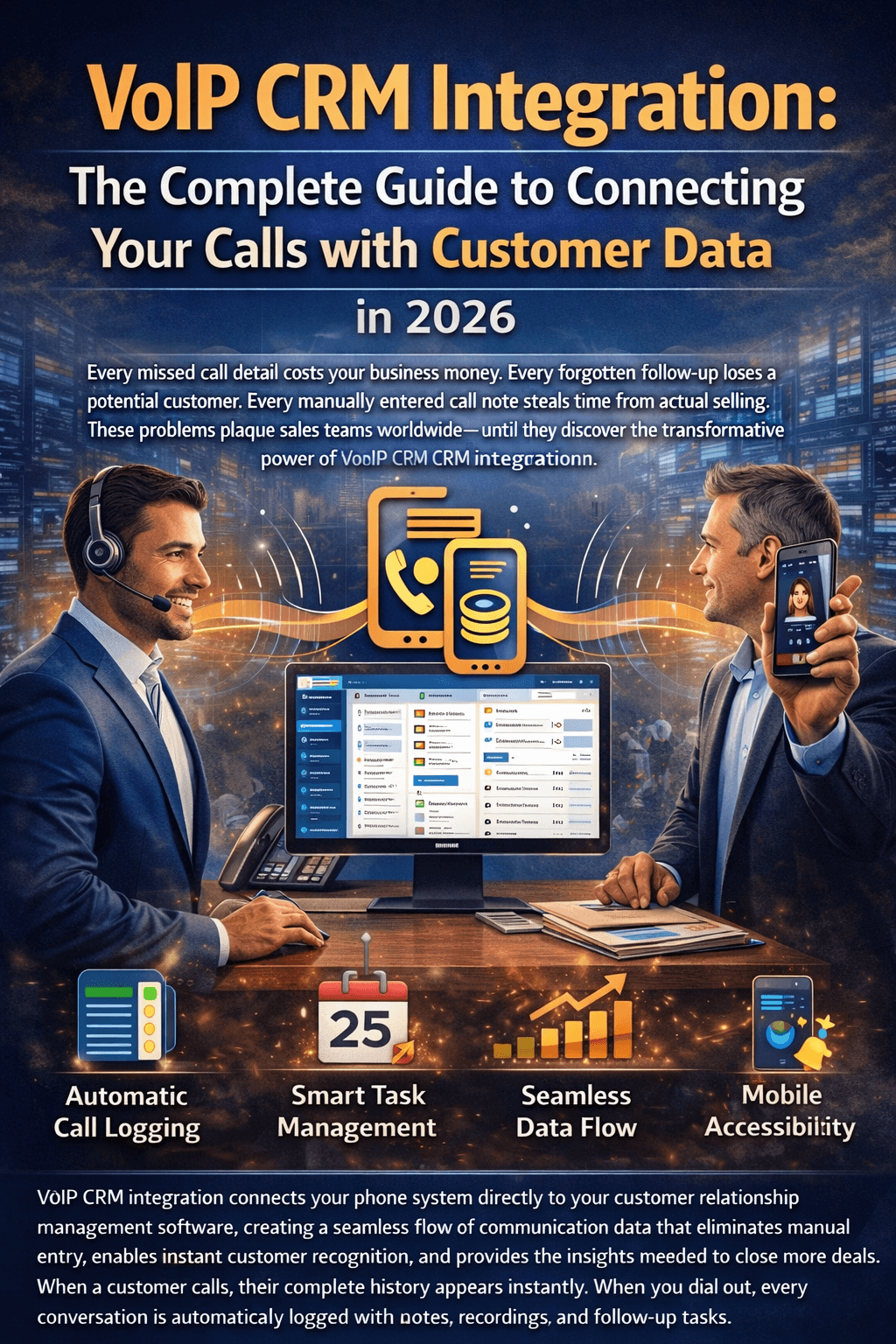
VoIP CRM Integration: The Complete Guide to Connecting Your Calls with
Customer Data in 2026
Every missed call detail costs
your business money. Every forgotten follow-up loses a potential customer.
Every manually entered call note steals time from actual selling. These
problems plague sales teams worldwide—until they discover the transformative
power of VoIP CRM integration.
VoIP CRM integration
connects your phone system directly to your customer relationship management
software, creating a seamless flow of communication data that eliminates manual
entry, enables instant customer recognition, and provides the insights needed
to close more deals. When a customer calls, their complete history appears
instantly. When you dial out, every conversation is automatically logged with
notes, recordings, and follow-up tasks.
The impact is dramatic. Sales
teams using integrated VoIP and CRM systems report 30-50% increases in
productive call time, significant improvements in lead conversion rates, and
substantial reductions in administrative overhead. Customer satisfaction scores
climb when representatives greet callers by name and reference their complete
history without awkward pauses.
This comprehensive guide
explores everything you need to know about VoIP CRM integration in 2026—from
understanding the core technology to selecting the right solution and
implementing it successfully. Whether you're running a small sales team or
managing an enterprise call center, you'll discover exactly how to leverage
this powerful combination for measurable business growth.
What is VoIP CRM Integration?
VoIP CRM integration refers
to the technological connection between Voice over Internet Protocol (VoIP)
phone systems and Customer Relationship Management (CRM) software. This
integration enables bidirectional data flow—phone systems access CRM data to
identify callers and display relevant information, while CRM platforms
automatically capture call details, recordings, and outcomes.
At its foundation, VoIP
technology transmits voice calls over the internet rather than traditional
telephone lines. This digital nature makes VoIP inherently more flexible and
integration-friendly than legacy phone systems. CRM software, meanwhile, serves
as the central repository for all customer information—contact details,
interaction history, purchase records, and relationship notes.
When you connect VoIP with
CRM software, these two systems communicate continuously. Incoming calls
trigger instant CRM lookups, displaying caller information before you even
answer. Outgoing calls initiate with a single click from any contact record.
Every conversation's metadata—duration, time, participants—flows automatically
into the CRM, creating comprehensive communication logs without manual
intervention.
How VoIP CRM Integration Works
The technical mechanics involve
several key components working together:
• API Connections: Application
Programming Interfaces enable secure data exchange between VoIP and CRM
platforms, synchronizing contact information and call data in real-time.
• CTI Technology: Computer
Telephony Integration creates the bridge between phone systems and computer
applications, enabling screen pops, click-to-dial, and call control from the
CRM interface.
• Webhooks & Triggers: Automated
notifications alert the CRM when call events occur—new incoming call, call
answered, call ended—triggering appropriate actions and data updates.
• Data Synchronization: Contact
records, call logs, recordings, and notes sync bidirectionally, ensuring both
systems maintain consistent, current information.
Are CRM and VoIP the Same Thing?
No—CRM and VoIP serve
fundamentally different purposes, though they complement each other powerfully
when integrated.
VoIP (Voice over Internet
Protocol) handles voice communication. It's your phone system, enabling you
to make and receive calls over internet connections rather than traditional
phone lines. VoIP provides calling features: dial tones, call routing,
voicemail, conferencing, and call recording.
CRM (Customer Relationship
Management) manages customer data and relationships. It stores contact
information, tracks interactions, manages sales pipelines, automates marketing,
and provides analytics on customer engagement patterns.
Think of VoIP as the
communication channel and CRM as the information repository. Integration
connects these systems so the communication channel feeds data to the
repository while the repository enriches the communication experience with
context.
Top Benefits of VoIP CRM Integration
Organizations implementing CRM
with VoIP integration experience transformative improvements across
multiple performance dimensions:
Click-to-Call Efficiency
Eliminate manual dialing
entirely. Every phone number in your CRM becomes a clickable link that
initiates calls instantly. Representatives save 5-10 seconds per call—time that
compounds dramatically across hundreds of daily calls. More importantly, this friction
reduction increases the calls actually made, directly impacting sales
productivity.
The efficiency extends beyond
speed. Click-to-call eliminates misdials, ensures correct numbers are called,
and automatically associates the call with the appropriate contact record. No
more calling the wrong person or losing track of which record to update.
Instant Caller Recognition with Screen Pop
When customers call, their
complete profile appears before you answer. Name, company, purchase history,
recent support tickets, outstanding invoices, previous conversation
notes—everything needed for personalized service displays instantly.
This VoIP solutions with
automatic CRM updates capability transforms customer experience. Instead of
asking callers to identify themselves and explain their situation,
representatives greet them personally and reference relevant context. The
impression: your company knows and values them individually.
Automatic Call Logging & CRM Updates
Manual call logging is tedious,
inconsistent, and often skipped entirely. Integrated systems log every call
automatically: timestamp, duration, direction (inbound/outbound),
caller/recipient identification, and disposition codes. Representatives simply
add notes about conversation content rather than recreating basic metadata.
The best VoIP solutions with
automatic CRM updates after each customer call go further with AI-powered
features. Speech recognition transcribes conversations into searchable text.
Sentiment analysis flags calls requiring manager attention. Action item
extraction identifies promised follow-ups and creates tasks automatically.
Call Recording & Transcription
VoIP solutions with real-time
transcription and CRM sync capture every word of every conversation. These
recordings serve multiple purposes:
• Training & Coaching: Review
actual calls to identify skill gaps and celebrate excellent customer
interactions.
• Quality Assurance: Monitor
service quality across your team with searchable conversation records.
• Compliance Documentation: Maintain
evidence of verbal agreements, disclosures, and consent for regulated
industries.
• Dispute Resolution: Reference
exactly what was said when questions arise about previous conversations.
Enhanced Analytics & Reporting
Integration creates
comprehensive data sets that neither system could provide independently.
Analyze call patterns alongside deal outcomes. Identify which conversation
characteristics correlate with closed sales. Track response times, call
durations, and contact frequency across your entire organization.
Sales managers gain
unprecedented visibility into team performance: calls made, calls answered,
talk time, conversion rates by rep, by campaign, by time period. This data
enables evidence-based coaching and resource allocation rather than guesswork.
Top 10 VoIP CRM Integration Solutions 2026
After extensive analysis of
integration depth, feature completeness, reliability, and user feedback, these
platforms deliver the best VoIP CRM integration experiences:
1. SMART ERP Suite — Best Native VoIP CRM Integration
Integration Score: ★★★★★ (9.9/10)
SMART ERP Suite stands apart
with native VoIP capabilities built directly into the CRM platform. Unlike
competitors requiring third-party VoIP providers and complex integrations,
SMART ERP Suite delivers calling functionality as a core feature—eliminating
integration headaches while ensuring seamless data synchronization.
The native approach provides
significant advantages: zero integration maintenance, guaranteed compatibility,
unified billing, single-vendor support, and features specifically designed to
work together. When the same company builds both the CRM and VoIP components,
the result is inherently more reliable and cohesive.
• Native HD Voice Calling: Crystal-clear
calls from within the CRM interface—no separate phone system required.
• Intelligent Screen Pop: Complete
customer profiles display instantly when calls connect, including custom fields
and recent activities.
• Power Dialer: Automated
dialing through call lists maximizes productive talk time by eliminating
voicemails and busy signals.
• AI Call Transcription: Every
conversation transcribed with speaker identification, keyword highlighting, and
sentiment scoring.
• Smart IVR Routing: Interactive
Voice Response menus route callers based on CRM data—VIP customers to senior
reps, support issues to specialists.
• SMS & WhatsApp
Integration: Unified messaging across voice and text channels from the same
interface.
• Real-Time Dashboards: Monitor
call activity, queue status, and team performance with live updating metrics.
Pricing starts at
$49/user/month with unlimited domestic calling included. The 30-day free trial
provides complete access to all VoIP features without requiring a credit card.
2. Zoho CRM VoIP Integration
Integration Score: ★★★★☆ (8.5/10)
Zoho CRM VoIP integration
leverages the PhoneBridge platform to connect with numerous VoIP providers
including RingCentral, Twilio, Vonage, and others. The marketplace approach
provides flexibility in choosing providers but introduces integration
complexity.
PhoneBridge enables basic
click-to-call and call logging across supported providers. Advanced features
like transcription and analytics depend on individual provider capabilities and
often require additional subscriptions. Best for organizations already using
Zoho CRM who want to add calling. Starting around $35/user/month plus VoIP
provider costs.
3. Salesforce VoIP CRM Integration
Integration Score: ★★★★☆ (8.3/10)
Salesforce CRM VoIP integration
connects through the AppExchange marketplace with dozens of compatible
telephony providers. Service Cloud Voice provides native capabilities for
enterprises, though at significant cost.
The Salesforce ecosystem offers
maximum flexibility and scalability but requires substantial investment in
implementation, customization, and ongoing administration. Total cost often
exceeds $200/user/month when combining Salesforce licensing with VoIP providers.
Best for large enterprises with dedicated Salesforce administrators.
4-10. Additional VoIP CRM Integration Options
•
4. HubSpot + VoIP (8.0/10): Integrates with Aircall, RingCentral,
and others. Good for inbound marketing-focused teams. VoIP requires separate
subscription.
•
5. Pipedrive + VoIP (7.8/10): Sales-focused CRM with calling
integrations. Excellent pipeline visualization but limited call center
features.
•
6. Freshsales (7.7/10): Built-in phone system with basic calling
features. Good value for small teams. Limited advanced VoIP capabilities.
•
7. Close CRM (7.5/10): Native calling designed for inside sales.
Power dialer and predictive dialing included. Limited for service/support use
cases.
•
8. Microsoft Dynamics 365 (7.3/10): Integrates with Teams Phone for
enterprise communications. Complex implementation but powerful when configured.
•
9. Agile CRM (7.0/10): Affordable option with Twilio integration.
Basic features suitable for small businesses.
•
10. Insightly (6.8/10): Project-focused CRM with VoIP integrations
through third-party connectors.
VoIP CRM Integration Feature Comparison
When evaluating VoIP CRM
integration platforms, these capabilities determine real-world value:
|
Feature |
SMART ERP |
Zoho + VoIP |
Salesforce |
HubSpot |
|
Native VoIP |
✓ |
✗ |
✗ |
✗ |
|
Click-to-Call |
✓ |
✓ |
✓ |
✓ |
|
Screen Pop |
✓ |
✓ |
✓ |
✓ |
|
Auto Call Logging |
✓ |
✓ |
✓ |
✓ |
|
Call Recording |
✓ |
Add-on |
Add-on |
Add-on |
|
AI Transcription |
✓ |
✗ |
Add-on |
Add-on |
|
Power Dialer |
✓ |
Add-on |
Add-on |
Add-on |
|
IVR Routing |
✓ |
Limited |
✓ |
✗ |
|
SMS Integration |
✓ |
✓ |
✓ |
✓ |
|
Free Trial |
30 days |
15 days |
30 days |
14 days |
|
Starting Price |
$49/mo |
$35+VoIP |
$150+VoIP |
$50+VoIP |
How to Integrate VoIP into CRM: Step-by-Step Guide
Understanding how to
integrate VoIP into CRM helps ensure successful implementation. Follow this
systematic approach:
Step 1: Assess Current Systems & Requirements
Document your existing CRM
platform, current phone system (if any), call volumes, team size, and specific
feature requirements. Identify must-have capabilities versus nice-to-haves.
Consider: Do you need call recording? AI transcription? IVR menus? International
calling?
Step 2: Choose Integration Approach
Three primary approaches exist:
• Native Integration
(Recommended): Choose a CRM with built-in VoIP like SMART ERP Suite.
Simplest implementation, best reliability, single vendor.
• Pre-Built Connector: Use
official integrations between your CRM and VoIP provider. Moderate complexity,
proven compatibility.
• Custom API Integration: Build
connections using APIs. Maximum flexibility but requires development resources
and ongoing maintenance.
Step 3: Configure Integration Settings
Configure the connection
between systems:
• Authenticate Accounts: Connect
CRM and VoIP accounts through OAuth or API keys.
• Map Data Fields: Define
how VoIP data maps to CRM fields—caller ID to contact records, call outcomes to
disposition fields.
• Set Call Routing Rules: Configure
IVR menus, ring groups, and routing logic based on CRM data.
• Enable Recording &
Transcription: Activate call recording with appropriate consent
notifications and storage settings.
Step 4: Test Thoroughly
Before full deployment, test
every integration point:
• Inbound Calls: Verify
screen pops display correct customer information.
• Outbound Calls: Confirm
click-to-dial works from all CRM locations.
• Call Logging: Ensure
calls log to correct contact records with accurate metadata.
• Recordings: Verify
recordings capture, store, and playback correctly.
• Mobile: Test
functionality on mobile devices for field sales teams.
Step 5: Train Team & Launch
Prepare your team with training
covering new workflows, interface changes, and productivity tips. Start with a
pilot group before full rollout. Gather feedback and refine configurations
based on real-world usage patterns.
VoIP CRM Integration by Industry
Different industries leverage
VoIP CRM integration for specific use cases:
Insurance VoIP CRM
Insurance VoIP CRM solutions
must handle high-volume outbound campaigns while maintaining strict compliance
documentation. Call recording captures verbal agreements and disclosures. Power
dialers work through lead lists efficiently. Screen pops display policy
details, claims history, and renewal dates.
Compliance requirements make
automatic call logging essential—regulators may request communication records
during audits. Integration ensures every customer interaction is documented
without relying on agent memory or manual entry.
Call Center CRM Integration
Call center CRM systems
require enterprise-grade capabilities: predictive dialers, queue management,
skills-based routing, real-time dashboards, and workforce management
integration. High call volumes demand efficiency features that maximize agent
productivity.
The best call center CRM
software provides supervisors with live monitoring capabilities—listening
to calls, coaching agents through whisper mode, and intervening when necessary.
Quality scoring integrates with CRM performance tracking for comprehensive
agent evaluation.
Home Improvement & HVAC VoIP CRM
HVAC VoIP CRM and home
improvement solutions connect office staff with field technicians while
maintaining centralized customer records. When customers call for service,
screen pops show equipment history, previous visits, and maintenance schedules.
Appointment scheduling
integrates with dispatch systems, while call recordings capture verbal
authorizations for work orders. Mobile apps enable field teams to access
customer information and log calls from job sites.
Solar VoIP CRM
Solar VoIP CRM platforms
support long sales cycles requiring numerous touchpoints. Lead qualification
calls, site assessment scheduling, proposal presentations, and closing
conversations all benefit from integration that maintains complete
communication history.
Power dialers help solar sales
teams work through large lead lists generated from canvassing and digital
campaigns. Call recordings document customer requirements and verbal
commitments throughout the multi-stage sales process.
Advanced VoIP CRM Integration Features
AI-Powered Call Transcription
Compare VoIP solutions with
real-time transcription and CRM sync to find platforms converting voice to
searchable text automatically. Modern AI accurately transcribes conversations
with speaker identification, enabling:
• Conversation Search: Find
specific discussions by searching transcript content rather than listening to
recordings.
• Keyword Alerts: Trigger
notifications when competitors, specific products, or compliance phrases are
mentioned.
• Automated Summaries: AI
generates call summaries highlighting key points, action items, and next steps.
• Sentiment Analysis: Detect
customer emotions throughout conversations to identify at-risk accounts.
Intelligent IVR & Call Routing
Advanced IVR systems access CRM
data to create personalized caller experiences. Rather than generic menus,
callers receive options relevant to their status: existing customers route
differently than prospects, VIP accounts skip queues, and callers with open
support tickets connect directly to assigned representatives.
CRM-driven routing considers
factors invisible to traditional phone systems: customer lifetime value, recent
purchase history, account manager assignments, and time zone preferences. This
intelligent distribution improves customer satisfaction while optimizing agent
utilization.
Frequently Asked Questions
What is VoIP in CRM?
VoIP in CRM refers to Voice
over Internet Protocol phone systems integrated with Customer Relationship
Management software. This integration enables click-to-call dialing, automatic
call logging, screen pops displaying customer information, and synchronized
communication records.
How do I integrate
VoIP into CRM?
You can integrate VoIP into CRM
through three approaches: choose a CRM with native VoIP (like SMART ERP Suite),
use pre-built connectors between your CRM and VoIP provider, or build custom
integrations using APIs. Native solutions offer the simplest implementation and
best reliability.
What is the best VoIP
CRM integration?
The best VoIP CRM
integration depends on your needs, but SMART ERP Suite offers the most
comprehensive native solution. For organizations already using specific CRMs,
provider-specific integrations (Zoho PhoneBridge, Salesforce Service Cloud
Voice) may be appropriate.
How much does VoIP CRM
integration cost?
Costs vary significantly.
Native solutions like SMART ERP Suite start at $49/user/month with calling
included. Third-party integration approaches combine CRM costs
($25-150/user/month) with separate VoIP subscriptions ($20-50/user/month) plus
potential integration platform fees.
Can I integrate VoIP
with Zoho CRM?
Yes, Zoho CRM VoIP
integration works through PhoneBridge, supporting providers including
RingCentral, Twilio, Vonage, and others. Configuration involves connecting your
VoIP provider account and mapping data fields between systems.
Does VoIP CRM
integration include call recording?
Most VoIP CRM integration
solutions include call recording, though storage limits and transcription
capabilities vary. SMART ERP Suite includes unlimited call recording with AI
transcription. Third-party providers may charge extra for recording storage or
transcription features.
Transform Your Sales Calls with SMART ERP Suite
Stop losing opportunities to
missed follow-ups and forgotten conversations. SMART ERP Suite's native VoIP
CRM integration connects every call to complete customer
context—automatically logging interactions, transcribing conversations, and
enabling the insights that close more deals.
Our all-in-one platform
eliminates the complexity of piecing together separate VoIP and CRM systems.
Everything works seamlessly because everything was built to work together.
✓ 30-Day Free Trial — Full VoIP features, no credit card
required
✓ Native VoIP Included — No third-party subscriptions
needed
✓ AI Call Transcription — Every conversation searchable
and summarized
✓ Unlimited Domestic Calling — Predictable costs with no
per-minute charges
✓ Power Dialer Included — Triple your team's productive
talk time
Start Your Free Trial →
www.smarterpsuite.com/voip-crm-integration