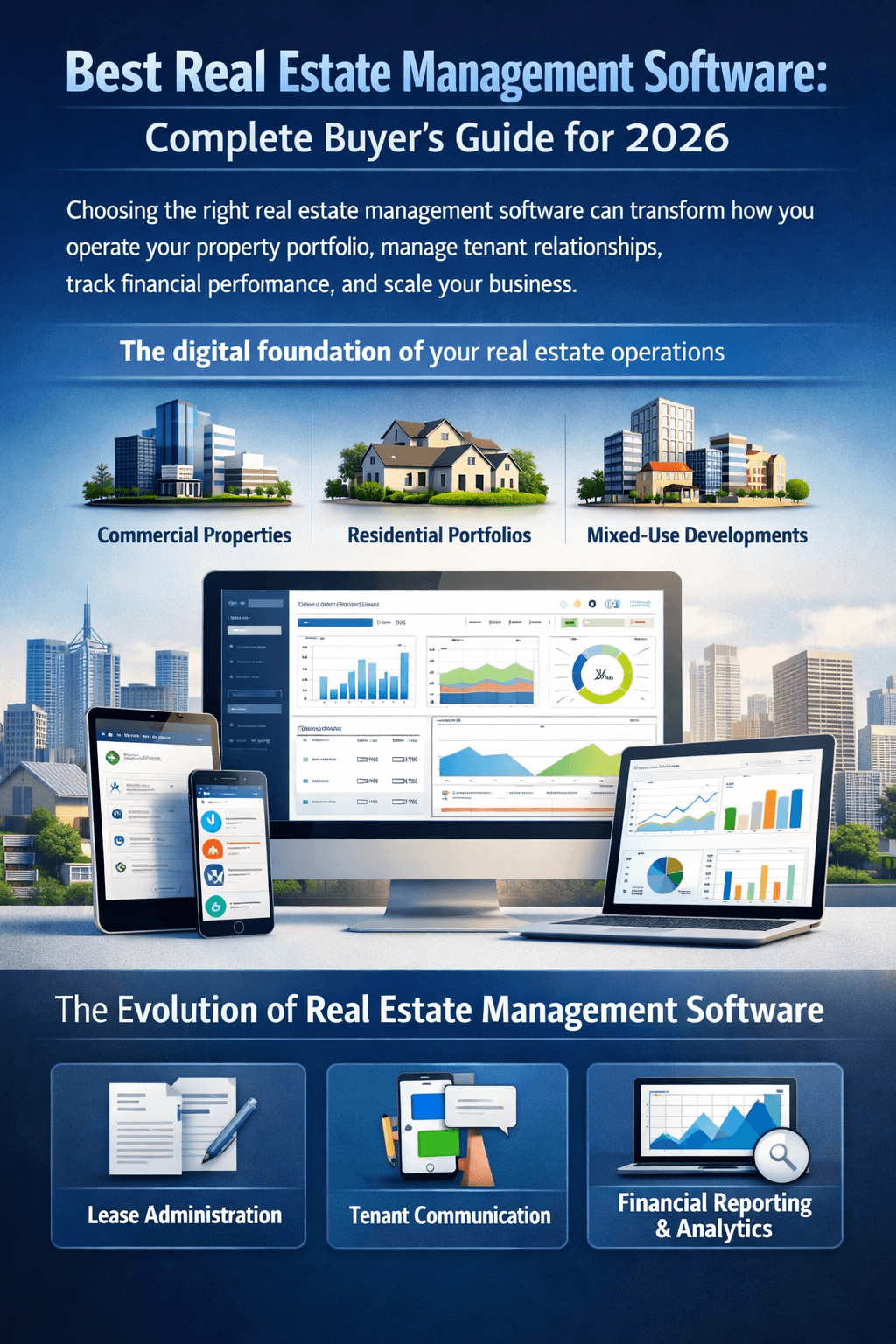
Best Real Estate Management Software: Complete Buyer's Guide for 2026
Choosing the right real estate management software can transform how you operate your property portfolio, manage tenant relationships, track financial performance, and scale your business. Whether you're managing commercial properties, residential portfolios, or mixed-use developments, the right software platform becomes the digital foundation of your real estate operations.
The real estate management software market has evolved dramatically over the past decade. Modern cloud-based platforms now integrate everything from lease administration and tenant communication to financial reporting and portfolio analytics—capabilities that previously required multiple disconnected systems.
This comprehensive guide examines the best real estate management software solutions for 2026, providing detailed analysis of features, pricing, implementation considerations, and selection criteria to help you make an informed decision.
What is Real Estate Management Software?
Real estate management software is a comprehensive digital platform designed to streamline and automate the operations, financial management, tenant relations, and portfolio oversight for property owners, investors, developers, and management companies.
Core Capabilities
Modern real estate management software encompasses several critical functional areas:
Property and Portfolio Management:
- Property database with comprehensive details (location, size, type, amenities)
- Document storage for leases, contracts, permits, and compliance records
- Visual portfolio dashboards showing occupancy, performance, and key metrics
- Multi-property and multi-location management
- Property inspection scheduling and tracking
Lease Administration:
- Lease tracking with automated renewals and expiration alerts
- Rent roll management with payment tracking
- CAM (Common Area Maintenance) reconciliation
- Lease abstracting and critical date management
- Variable rent calculations (percentage rent, CPI adjustments)
Financial Management:
- Accounts payable and receivable
- General ledger and chart of accounts
- Budgeting and forecasting by property
- Financial reporting (P&L, balance sheet, cash flow)
- Owner and investor distributions
- Property-level and portfolio-level analytics
Tenant and Customer Relationship Management:
- Tenant database with contact information and lease details
- Communication tools (email, SMS, portal)
- Maintenance request tracking
- Tenant portal for payments and communication
- Lease renewal management
Maintenance and Work Orders:
- Preventive maintenance scheduling
- Work order creation, assignment, and tracking
- Vendor management and contractor coordination
- Asset and equipment tracking
- Maintenance history and cost tracking
Reporting and Analytics:
- Standard financial reports (P&L, balance sheet, AR aging)
- Occupancy and vacancy analysis
- Rent roll and lease expiration reports
- Portfolio performance dashboards
- Custom report builder
Types of Real Estate Management Software
Commercial Real Estate Management Software: Designed for office buildings, retail centers, industrial properties, and mixed-use developments. Emphasizes complex lease structures, CAM reconciliation, and sophisticated financial reporting.
Residential Property Management Software: Focuses on apartment communities, single-family rentals, and multi-family properties. Prioritizes tenant screening, online rent collection, and maintenance coordination.
Real Estate Portfolio Management Software: Built for investors and funds managing multiple properties across different asset classes. Emphasizes portfolio-level analytics, investor reporting, and performance tracking.
Real Estate Asset Management Software: Designed for institutional investors and REITs tracking property valuations, investment performance, and strategic asset allocation.
Real Estate Project Management Software: Tailored for developers managing construction projects, including budgets, schedules, vendor coordination, and project milestones.
Why You Need Real Estate Management Software
Operational Efficiency
Manual processes consume enormous time and create opportunities for errors. Real estate management software automates routine tasks including:
- Rent collection and payment processing
- Late payment reminders and fee calculation
- Lease renewal notifications
- Maintenance request routing
- Document generation and distribution
- Financial statement preparation
Properties typically reduce administrative time by 40-60% after implementing comprehensive management software.
Financial Accuracy and Visibility
Spreadsheet-based financial management introduces errors, lacks audit trails, and provides limited visibility. Professional software ensures:
- Accurate accounting with built-in controls
- Real-time financial dashboards
- Property-level profitability analysis
- Cash flow forecasting
- Automated reconciliation
- Audit-ready financial records
Improved Tenant Experience
Modern tenants expect digital experiences. Management software enables:
- Online rent payment with multiple methods
- 24/7 tenant portal access
- Easy maintenance request submission
- Electronic lease signing
- Automated communication and notifications
- Transparent account information
Properties with tenant portals report 85% higher tenant satisfaction and 40% faster rent collection.
Better Decision Making
Data-driven decisions require accessible, accurate information. Management software provides:
- Portfolio performance analytics
- Occupancy trends and forecasting
- Rental rate optimization insights
- Expense analysis and benchmarking
- Investment return calculations
- Scenario modeling capabilities
Scalability
Growing portfolios become increasingly complex to manage manually. Software enables efficient scaling through:
- Standardized processes across properties
- Centralized management of multiple locations
- Automated workflows reducing per-property overhead
- Role-based access for distributed teams
- Consistent reporting across portfolio
Compliance and Risk Management
Real estate operations face numerous compliance requirements. Software helps through:
- Automated compliance tracking and deadlines
- Document retention and organization
- Audit trail for all transactions and changes
- Fair housing compliance tools
- Security deposit regulations adherence
- Financial reporting standards compliance
Top Real Estate Management Software Solutions for 2026
1. SMART ERP Suite for Real Estate
SMART ERP Suite delivers comprehensive real estate management capabilities within a unified cloud platform designed specifically for property owners, investors, and management companies.
Key Features:
- Multi-property portfolio management with visual dashboards
- Complete lease lifecycle management with automated workflows
- Integrated accounting with property-level and portfolio-level reporting
- Tenant portal with online payments and maintenance requests
- Advanced analytics and custom reporting
- Mobile apps for iOS and Android
- VoIP integration for property management calls
- Document management with e-signature capabilities
Pricing: Starting at $89/user/month with no hidden fees
Best For: Commercial real estate firms, property management companies, and real estate investors managing 10-1000+ properties
Why Choose SMART ERP Suite:
- Industry-specific features built for real estate operations
- Rapid 90-day implementation methodology
- Comprehensive training and 24/7 support
- 99.9% uptime SLA with enterprise security
- Flexible and customizable to your workflows
- Integrated CRM for prospect and tenant management
Schedule a demo or start your free 30-day trial
2. Yardi Voyager
Yardi is one of the largest and most established real estate management platforms, serving commercial, residential, and mixed-use properties globally.
Key Features:
- Comprehensive property accounting and financial management
- Lease administration and CAM reconciliation
- Investment management and portfolio analytics
- Procurement and vendor management
- Energy management and sustainability tracking
Pricing: Custom pricing (typically $100-200+/user/month)
Best For: Large commercial real estate portfolios, REITs, and institutional property owners
Considerations: Complex implementation (6-12 months), steep learning curve, requires significant IT resources
3. RealPage
RealPage offers a suite of software solutions for residential and commercial property management with emphasis on multifamily properties.
Key Features:
- Accounting and financial reporting
- Leasing and marketing automation
- Resident screening and onboarding
- Utility billing and RUBS
- Revenue management and dynamic pricing
Pricing: Custom pricing based on units and features
Best For: Multifamily property management companies and apartment communities
Considerations: Best suited for residential focus, modular pricing can become expensive
4. MRI Software
MRI provides commercial and residential property management solutions with strong international capabilities.
Key Features:
- Property accounting and financial reporting
- Lease management and administration
- Facilities and maintenance management
- Investment and portfolio management
- Business intelligence and analytics
Pricing: Custom enterprise pricing
Best For: Global property portfolios, commercial real estate, and mixed-use developments
Considerations: Implementation complexity, higher cost structure, best for larger organizations
5. AppFolio
AppFolio focuses on residential property management with user-friendly interfaces and modern features.
Key Features:
- Online rent collection and tenant screening
- Maintenance request management
- Accounting and financial reporting
- Owner and investor portals
- Marketing and leasing tools
Pricing: Starting at $280/month plus $1/unit
Best For: Small to mid-sized residential property management companies
Considerations: Limited commercial real estate features, primarily residential-focused
6. Buildium
Buildium serves residential property managers and community associations with affordable, easy-to-use software.
Key Features:
- Rent collection and tenant screening
- Accounting and financial reporting
- Maintenance tracking
- Owner and board member portals
- Leasing and marketing automation
Pricing: Starting at $50/month for up to 20 units
Best For: Small residential property managers and HOA management
Considerations: Limited for commercial properties or large portfolios
7. Rent Manager
Rent Manager offers comprehensive property management software for commercial and residential properties.
Key Features:
- Accounting and financial management
- Lease tracking and renewals
- Maintenance management
- Tenant and owner portals
- Custom reporting and analytics
Pricing: One-time license fee (typically $2,000-5,000) plus annual support
Best For: Mid-sized property management companies seeking on-premise or cloud deployment
Considerations: One-time license model requires upfront investment
8. Propertyware
Propertyware provides cloud-based property management software for single-family and small residential portfolios.
Key Features:
- Owner and investor portals
- Tenant screening and leasing
- Maintenance coordination
- Accounting and trust accounting
- Inspection and compliance tracking
Pricing: Starting at $1/unit/month plus base fee
Best For: Single-family rental property managers and small residential portfolios
Considerations: Best for residential, limited commercial capabilities
9. Entrata
Entrata offers an all-in-one platform for multifamily property management with extensive features.
Key Features:
- Accounting and financial management
- Leasing and marketing automation
- Resident portal and online payments
- Utility billing and RUBS
- Revenue management
Pricing: Custom pricing based on units
Best For: Large multifamily communities and apartment operators
Considerations: Primarily multifamily focus, significant implementation effort
10. Skyline Intellisite
Skyline specializes in condominium, HOA, and community association management.
Key Features:
- Accounting and financial reporting
- Owner and board portals
- Violation tracking and compliance
- Document management
- Reserve fund management
Pricing: Custom pricing based on units
Best For: Community associations, condominiums, and HOA management
Considerations: Specialized for associations rather than rental properties
Commercial Real Estate Management Software: Key Considerations
Commercial properties have unique requirements that differentiate them from residential management:
Complex Lease Structures
Commercial leases involve sophisticated terms including:
Triple Net (NNN) Leases: Tenants pay base rent plus property taxes, insurance, and maintenance costs. Software must track and reconcile these separate charges.
Percentage Rent: Retail tenants pay base rent plus percentage of sales above threshold. Requires sales reporting integration and automatic calculation.
CAM Reconciliation: Common Area Maintenance costs are estimated annually, charged monthly, and reconciled at year-end. Complex calculations require specialized software.
Variable Rent Adjustments: CPI increases, fixed percentage escalations, or market-based adjustments need automated tracking and application.
Longer Lease Terms
Commercial leases typically span 5-20 years with multiple renewal options, rent escalations, and modification amendments. Software must track these complex timelines and automatically alert managers of critical dates.
Higher Financial Stakes
Individual commercial leases often represent millions in annual revenue. Accuracy in billing, reconciliation, and financial reporting is critical.
Tenant Improvement and Leasing Commissions
Commercial properties involve significant tenant improvement allowances and brokerage commissions. Software should track these costs, amortization schedules, and impact on property-level profitability.
Property-Level Financial Analysis
Commercial investors need detailed property-level income statements, cash flow analysis, capital expenditure tracking, and return calculations (IRR, NOI, cap rate).
Best Commercial Real Estate Management Software:
- SMART ERP Suite (comprehensive, flexible, modern interface)
- Yardi Voyager (enterprise-scale, feature-rich)
- MRI Software (global capabilities, strong for mixed-use)
- Rent Manager (mid-market, flexible deployment)
Real Estate Portfolio Management Software: Analytics and Performance Tracking
Portfolio-level management requires different capabilities than individual property operations:
Consolidated Financial Reporting
View performance across all properties with:
- Portfolio-wide P&L and balance sheets
- Aggregated cash flow statements
- Comparative property performance analysis
- Roll-up reporting by property type, geography, or custom groupings
Portfolio Analytics and Metrics
Track key performance indicators including:
Occupancy Metrics:
- Physical occupancy vs economic occupancy
- Tenant retention rates
- Lease expiration schedules
- Average lease term remaining
Financial Performance:
- Net Operating Income (NOI) by property and portfolio
- Cap rate analysis
- Return on investment (ROI) and Internal Rate of Return (IRR)
- Same-store sales growth
- Revenue per square foot
Operational Efficiency:
- Operating expense ratios
- Maintenance costs per square foot
- Administrative costs as percentage of revenue
- Vacancy loss and concession tracking
Investment Management
Portfolio software should support:
- Property acquisition analysis and due diligence
- Capital allocation and deployment tracking
- Disposition planning and analysis
- Investment committee reporting
- Investor and partner distributions
Scenario Modeling
Test various strategies through:
- Rent increase scenarios
- Refinancing analysis
- Acquisition impact modeling
- Disposition waterfall calculations
- Portfolio optimization recommendations
Geographic and Asset Class Analysis
Analyze performance by:
- Geographic market or region
- Asset class (office, retail, industrial, multifamily)
- Vintage or acquisition cohort
- Property size or value tier
Best Portfolio Management Software:
- SMART ERP Suite (unified platform, advanced analytics)
- Yardi Voyager (comprehensive portfolio tools)
- MRI Software (strong investment management)
- RealPage (good for multifamily portfolios)
Real Estate Asset Management Software: Institutional Features
Institutional investors and REITs require specialized asset management capabilities:
Property Valuation Tracking
Monitor property values through:
- Automated valuation models (AVMs)
- Appraisal management and tracking
- Market comparable analysis
- Fair value accounting for financial reporting
- Impairment testing and analysis
Capital Planning and Budgeting
Manage capital across portfolio:
- Capital expenditure budgeting by property
- Capital allocation optimization
- Project tracking and cost management
- Return on capital employed analysis
- Capital needs forecasting
Strategic Asset Planning
Develop and execute asset strategies:
- Hold/sell/reposition analysis
- Property repositioning plans and tracking
- Redevelopment project management
- Highest and best use analysis
- Strategic plan documentation and review
Investor Reporting
Provide transparency to investors through:
- Quarterly investment performance reports
- Customizable investor portals
- Distribution calculations and processing
- K-1 tax reporting
- Compliance reporting for various regulations
Risk Management
Identify and monitor risks including:
- Market risk analysis
- Tenant concentration risk
- Lease rollover risk
- Geographic concentration
- Interest rate sensitivity
Compliance and Governance
Maintain compliance with:
- REIT qualification requirements
- Sarbanes-Oxley (SOX) controls
- Financial reporting standards (GAAP, IFRS)
- Investment policy compliance
- Corporate governance requirements
Best Asset Management Software:
- SMART ERP Suite (flexible, comprehensive)
- Yardi Voyager (enterprise features, strong compliance)
- MRI Software (institutional capabilities)
Real Estate Project Management Software: Development and Construction
Real estate developers need specialized project management capabilities:
Project Planning and Scheduling
Manage development timeline through:
- Critical path method (CPM) scheduling
- Gantt charts and milestone tracking
- Dependency management
- Resource allocation and leveling
- What-if scenario planning
Budget Management
Control project costs with:
- Detailed cost estimating
- Budget vs actual tracking
- Change order management
- Commitment tracking (contracts, purchase orders)
- Cost forecasting and variance analysis
- Draw request management
Vendor and Contractor Management
Coordinate the development team:
- Bid management and comparison
- Contract administration
- Vendor performance tracking
- Insurance and compliance documentation
- Lien waiver tracking
- Payment application processing
Document Control
Organize project documentation:
- Drawing and specification management
- RFI (Request for Information) tracking
- Submittal management
- Meeting minutes and correspondence
- As-built documentation
- Warranty and O&M manuals
Quality and Safety
Ensure project quality:
- Punch list management
- Inspection scheduling and tracking
- Safety incident reporting
- Quality control checklists
- Non-conformance tracking
Project Analytics
Monitor project health:
- Earned value analysis
- Schedule performance index (SPI)
- Cost performance index (CPI)
- Project profitability forecasting
- Resource utilization reports
Best Project Management Software for Real Estate:
- Procore (construction-focused, industry leader)
- Buildertrend (residential development)
- CoConstruct (custom home builders)
- SMART ERP Suite (integrated with property management)
How to Choose the Right Real Estate Management Software
Selecting appropriate software requires systematic evaluation:
Step 1: Define Your Requirements
Property Portfolio Characteristics:
- Number of properties and units
- Property types (commercial, residential, mixed-use)
- Geographic distribution
- Total portfolio value
- Growth projections (units per year)
Functional Requirements:
- Lease administration complexity
- Financial reporting needs
- Tenant portal requirements
- Maintenance management
- Integration requirements
- Mobile access needs
User Requirements:
- Number of users by role
- Technical sophistication of users
- Training resources available
- Support requirements
Budget Parameters:
- Initial implementation budget
- Monthly/annual operating budget
- Total cost of ownership tolerance
- ROI requirements and timeline
Step 2: Research and Shortlist
Research Sources:
- Software review sites (Capterra, G2, Software Advice)
- Industry publications and analyst reports
- Peer recommendations and references
- Vendor websites and demo videos
- Industry association resources
Initial Screening Criteria:
- Property type specialization
- Company size fit
- Deployment model (cloud vs on-premise)
- Pricing transparency and fit
- Implementation timeline
- Vendor stability and reputation
Create Shortlist: Narrow to 3-5 solutions that best match requirements. Too many evaluations create decision fatigue; too few limit options.
Step 3: Evaluate Features and Fit
Core Functionality Assessment: Rate each solution on must-have features:
- Property and portfolio management (1-10)
- Lease administration (1-10)
- Financial management (1-10)
- Tenant management (1-10)
- Maintenance management (1-10)
- Reporting and analytics (1-10)
Usability Evaluation:
- Interface intuitiveness
- Mobile experience
- Learning curve
- Customization options
- Workflow efficiency
Technical Evaluation:
- Security and compliance certifications
- System performance and reliability
- Integration capabilities and ecosystem
- Data migration tools and support
- API documentation and flexibility
Step 4: Request Demonstrations
Prepare for Demos:
- Share specific requirements document
- Provide sample data scenarios
- Prepare questions list
- Include key stakeholders
- Allow 90-120 minutes per demo
What to Evaluate:
- How well demo addresses your specific scenarios
- Ease of common tasks (lease entry, payment processing, reporting)
- Handling of edge cases and exceptions
- Mobile functionality demonstration
- Integration capabilities
- Customization examples
Ask Critical Questions:
- What's the typical implementation timeline?
- What's included in pricing vs additional costs?
- How are updates and new features delivered?
- What training and support is provided?
- Can you provide references in our industry?
- What's your customer retention rate?
- How is data security and backup handled?
Step 5: Check References
Select References: Request 3-5 references with similar:
- Portfolio size and complexity
- Property types
- Company structure
- Implementation timeframe (within last 2 years)
Reference Questions:
- How long did implementation actually take?
- What challenges did you encounter?
- How responsive is customer support?
- How often do you use the software daily?
- What features do you wish it had?
- Would you choose this software again?
- What's been the impact on your operations?
Step 6: Total Cost Analysis
Calculate true 5-year cost including:
Upfront Costs:
- Software licenses or subscription
- Implementation and configuration
- Data migration
- Integration development
- Initial training
- Hardware (if on-premise)
Ongoing Costs:
- Monthly or annual subscription
- Support and maintenance fees
- Additional user licenses
- Storage or usage overages
- Ongoing training
- Integration maintenance
- Software updates (if on-premise)
Hidden Costs:
- Customization development
- Third-party add-ons
- Consulting and optimization
- Additional modules not in base package
Step 7: Pilot or Trial
If possible, conduct a pilot:
- Use actual property data
- Test critical workflows
- Involve actual end users
- Run for 30-60 days minimum
- Document issues and questions
- Measure actual time savings
Step 8: Make Decision
Scoring Framework: Weight criteria by importance:
- Feature fit: 35%
- Total cost: 25%
- Vendor reputation and stability: 15%
- Implementation and support: 15%
- Integration and technical capabilities: 10%
Final Considerations:
- Internal consensus and buy-in
- Contract terms and flexibility
- Vendor roadmap alignment
- Migration path from current system
- Risk mitigation strategies
Real Estate Management Software Implementation Best Practices
Successful implementation requires careful planning and execution:
Phase 1: Planning (4-6 weeks)
Project Team Formation:
- Executive sponsor (decision authority)
- Project manager (day-to-day coordination)
- Subject matter experts (operations, accounting, leasing)
- IT representative (integrations, security)
- Change management lead (training, adoption)
Project Planning:
- Define scope and objectives
- Establish timeline and milestones
- Identify risks and mitigation strategies
- Create communication plan
- Establish success metrics
Data Preparation:
- Audit existing data quality
- Clean and standardize data
- Archive historical information
- Map data fields to new system
- Establish data migration approach
Phase 2: Configuration (6-10 weeks)
System Setup:
- Configure company and property structures
- Set up chart of accounts
- Define user roles and permissions
- Configure workflows and approvals
- Establish document templates
- Set up integration connections
Customization:
- Configure custom fields
- Build custom reports
- Design dashboard layouts
- Customize forms and documents
- Configure automated workflows
Testing:
- Unit testing of individual features
- Integration testing across modules
- User acceptance testing
- Performance and load testing
- Security testing
Phase 3: Data Migration (2-4 weeks)
Migration Planning:
- Determine cutover date
- Establish data migration sequence
- Plan for parallel operations period
- Define validation criteria
- Prepare rollback procedures
Data Migration Execution:
- Test migration with sample data
- Perform full data migration
- Validate data accuracy and completeness
- Reconcile financials
- Address migration issues
Phase 4: Training (3-4 weeks)
Training Development:
- Create role-specific training materials
- Develop video tutorials
- Build quick reference guides
- Establish internal help resources
Training Delivery:
- Conduct hands-on training sessions
- Provide practice environment
- Offer office hours for questions
- Certify super users
- Create feedback mechanisms
Phase 5: Go-Live and Stabilization (2-4 weeks)
Go-Live:
- Execute cutover plan
- Monitor system performance
- Provide intensive user support
- Track and resolve issues quickly
- Communicate status regularly
Stabilization:
- Monitor adoption and usage
- Address user questions and issues
- Fine-tune configurations
- Optimize workflows
- Collect feedback for improvements
Post-Implementation:
- Conduct lessons learned review
- Document best practices
- Plan ongoing optimization
- Establish continuous improvement process
- Measure against success metrics
Typical Implementation Timeline: 3-6 months
SMART ERP Suite implementation services include dedicated project management, comprehensive training, and post-go-live support to ensure successful deployment.
Real Estate Management Software Pricing Models
Understanding pricing structures helps with accurate budgeting:
Subscription-Based Pricing (SaaS)
Per User Per Month:
- Typical range: $50-$200 per user monthly
- Scales with team size
- Includes software, hosting, maintenance, updates
- Predictable operating expense
- Example: SMART ERP Suite starts at $89/user/month
Per Unit/Property:
- Typical range: $1-$10 per unit monthly
- Scales with portfolio size
- May have minimum monthly fees
- Better for large portfolios with small teams
- Example: Propertyware at $1/unit/month
Tiered Pricing:
- Different feature sets at different price points
- Basic, Professional, Enterprise levels
- Common structure:
- Basic: $2,000-$5,000/month (limited features)
- Professional: $5,000-$15,000/month (standard features)
- Enterprise: $15,000+/month (full features)
Perpetual License Pricing
One-Time License Fee:
- Typical range: $10,000-$100,000+
- Based on modules and users
- Requires annual maintenance (15-20% of license)
- Large upfront investment
- Declining in popularity
Custom Enterprise Pricing
Negotiated Pricing:
- Large portfolios (1,000+ units)
- Complex requirements
- Custom development included
- Multi-year contracts
- Volume discounts
Additional Costs to Consider
Implementation Fees:
- Configuration and setup: $5,000-$50,000+
- Data migration: $2,000-$20,000
- Integration development: $5,000-$50,000
- Training: $2,000-$10,000
Optional Add-Ons:
- Additional modules
- Extra storage
- Advanced features
- Premium support
- Custom development
Third-Party Costs:
- Payment processing fees (2-3% of transactions)
- Background check services
- Insurance verification
- Marketing integrations
- Accounting system interfaces
Total Cost of Ownership Example (100 units, 5 users)
Cloud SaaS Solution:
- Subscription: $5,000/year ($100/user/month × 5 users × 12 months)
- Implementation: $10,000 one-time
- Training: $3,000 one-time
- Payment processing: $2,000/year
- 5-Year Total: $48,000
On-Premise Solution:
- License: $25,000 one-time
- Implementation: $15,000 one-time
- Annual maintenance: $5,000/year
- Hardware/server: $5,000 one-time
- IT support: $10,000/year (part-time)
- 5-Year Total: $120,000
Cloud solutions typically cost 50-70% less over five years for small to mid-sized portfolios.
Integration Requirements for Real Estate Management Software
Modern real estate operations require multiple connected systems:
Accounting System Integration
QuickBooks Integration:
- Synchronize chart of accounts
- Export journal entries
- Import vendor bills
- Reconcile transactions
- Generate financial reports
Benefits: Maintain books in familiar accounting software while using specialized property management features
Payment Processing Integration
Stripe, PayPal, Authorize.net:
- Online rent collection
- ACH and credit card processing
- Automated payment reminders
- Failed payment handling
- PCI compliance
Benefits: Reduce collection time, improve cash flow, decrease processing costs
CRM Integration
Salesforce, HubSpot Integration:
- Sync prospect and tenant data
- Track leasing pipeline
- Automate marketing campaigns
- Monitor communication history
- Analyze lead sources
Benefits: Unified view of prospects and tenants, improved leasing efficiency
Communication Platform Integration
Email, SMS, VoIP:
- Automated notifications
- Bulk communications
- Two-way text messaging
- Click-to-call functionality
- Call logging and recording
Benefits: Streamlined communication, improved response times, better documentation
SMART ERP Suite VoIP integration enables click-to-call from tenant records, automatic call logging, and comprehensive communication tracking.
Background Check and Screening
TransUnion, Experian, RentPrep:
- Credit report retrieval
- Criminal background checks
- Eviction history
- Income verification
- Automated decision criteria
Benefits: Faster tenant screening, reduced risk, consistent evaluation
Maintenance and Vendor Management
ServiceChannel, CMMS Systems:
- Work order synchronization
- Vendor bidding and selection
- Preventive maintenance scheduling
- Asset tracking integration
- Invoice reconciliation
Benefits: Improved maintenance efficiency, vendor accountability, cost tracking
Marketing and Listing Platforms
Zillow, Apartments.com, CoStar:
- Automated listing syndication
- Lead capture and routing
- Pricing optimization
- Market analytics
- Availability updates
Benefits: Increased exposure, streamlined marketing, faster lease-up
Document Management and E-Signature
DocuSign, Adobe Sign, HelloSign:
- Electronic lease execution
- Document workflow automation
- Secure document storage
- Audit trail compliance
- Mobile signing capabilities
Benefits: Faster lease execution, reduced paper costs, improved compliance
Utility Management
Utility billing services:
- Utility data import
- RUBS (Ratio Utility Billing System) calculation
- Tenant billing
- Payment tracking
- Reconciliation
Benefits: Utility cost recovery, accurate billing, reduced administrative time
Business Intelligence and Analytics
Tableau, Power BI:
- Advanced data visualization
- Custom dashboards
- Predictive analytics
- Trend analysis
- Portfolio benchmarking
Benefits: Deeper insights, better decision-making, competitive intelligence
Real Estate Management Software Security and Compliance
Security and compliance are critical for protecting sensitive data:
Data Security Requirements
Encryption:
- Data encryption at rest (AES-256)
- Data encryption in transit (TLS 1.2+)
- Database encryption
- Backup encryption
Access Controls:
- Multi-factor authentication (MFA)
- Role-based access control (RBAC)
- Granular permission settings
- Session management and timeouts
- IP whitelisting options
Infrastructure Security:
- SOC 2 Type II certification
- Regular security audits
- Penetration testing
- Vulnerability scanning
- Security patch management
Data Protection:
- Regular automated backups
- Geographic redundancy
- Disaster recovery procedures
- Business continuity planning
- Data retention policies
Compliance Considerations
Fair Housing Compliance:
- Non-discriminatory tenant screening
- Compliant application processing
- Documentation of decision criteria
- Accessibility features (ADA compliance)
Financial Regulations:
- Trust accounting separation
- Security deposit regulations
- Escrow account management
- 1099 reporting
- Sales tax collection and remittance
Privacy Regulations:
- GDPR compliance (for EU properties)
- CCPA compliance (California)
- Data subject access requests
- Right to deletion
- Privacy policy documentation
Industry Standards:
- Generally Accepted Accounting Principles (GAAP)
- Financial Accounting Standards Board (FASB) guidelines
- Real Estate Investment Trust (REIT) requirements
- Sarbanes-Oxley (SOX) controls for public companies
Audit and Reporting
Audit Trail:
- Complete change history
- User activity logging
- System access tracking
- Report generation history
- Data export tracking
Compliance Reporting:
- Fair housing documentation
- Financial audit reports
- Security deposit compliance
- Lease audit trails
- Tax reporting (1099, sales tax)
Mobile Real Estate Management: Apps and Features
Mobile capabilities have become essential for modern property management:
Essential Mobile Features
Property Inspections:
- Photo and video capture
- Inspection checklists
- Voice notes
- Offline functionality
- GPS tagging
Maintenance Management:
- Work order creation
- Vendor assignment
- Photo documentation
- Status updates
- Completion verification
Tenant Communication:
- In-app messaging
- Push notifications
- Document sharing
- Emergency contact
- Payment reminders
Showings and Leasing:
- Showing scheduling
- Virtual tours
- Application submission
- Document signing
- Credit check initiation
Financial Management:
- Expense recording
- Receipt capture
- Approval workflows
- Financial dashboards
- Payment tracking
Mobile-First Platforms
SMART ERP Suite Mobile:
- Native iOS and Android apps
- Full feature parity with desktop
- Offline capabilities
- Biometric authentication
- Real-time synchronization
Benefits of Mobile Access:
- Respond to issues faster
- Update information in real-time
- Work efficiently on-site
- Improve tenant satisfaction
- Reduce administrative delays
Frequently Asked Questions
What is the best real estate management software for small portfolios? For portfolios under 50 units, consider Buildium, Propertyware, or SMART ERP Suite depending on property type. SMART ERP Suite offers the most comprehensive features starting at $89/user/month, while Buildium provides a more affordable entry point for basic residential needs.
How much does real estate management software cost? Pricing varies significantly based on portfolio size and features. Expect $50-$200 per user per month for cloud solutions, or $1-$10 per unit monthly. Total costs for a 100-unit portfolio typically range from $3,000-$15,000 annually including implementation.
Can real estate management software integrate with QuickBooks? Yes, most modern platforms offer QuickBooks integration either natively or through third-party connectors. Integration typically synchronizes chart of accounts, journal entries, and financial transactions between systems.
What's the difference between property management and real estate management software? Property management software focuses on day-to-day operations (rent collection, maintenance, tenant communication), while real estate management software includes broader capabilities like portfolio analytics, investment management, and strategic planning. Many platforms now offer both.
How long does it take to implement real estate management software? Implementation typically takes 3-6 months depending on portfolio size and complexity. Cloud solutions generally deploy faster (8-12 weeks) than on-premise systems (4-6 months). SMART ERP Suite's 90-day methodology accelerates time-to-value.
Is cloud-based or on-premise real estate management software better? Cloud-based solutions offer lower costs, faster deployment, automatic updates, anywhere access, and professional security. On-premise may be preferred for specific compliance requirements or unreliable internet connectivity, but represents only 10-15% of new deployments.
What features should I prioritize in commercial real estate management software? For commercial properties, prioritize lease administration (CAM reconciliation, percentage rent, escalations), property-level financial reporting, tenant improvement tracking, critical date management, and sophisticated reporting capabilities.
Can real estate management software handle multiple property types? Quality platforms like SMART ERP Suite support mixed portfolios including commercial, residential, retail, industrial, and specialized properties within a single system. Look for flexible lease structures, customizable fields, and property-type-specific features.
How does real estate management software improve tenant retention? Software improves retention through online payment convenience, responsive maintenance tracking, transparent communication, tenant portals for self-service, and automated but personalized engagement that builds positive tenant experiences.
What mobile capabilities should real estate management software include? Essential mobile features include work order management, property inspections, tenant communication, financial dashboards, showing scheduling, and offline functionality. Native iOS and Android apps provide better experience than mobile-responsive web interfaces.
Conclusion
Selecting the right real estate management software transforms property operations, improves financial performance, enhances tenant satisfaction, and enables portfolio growth. The market offers solutions for every property type, portfolio size, and operational requirement—from simple residential management to sophisticated institutional asset management.
Key Decision Factors:
For Commercial Real Estate: Choose platforms with robust lease administration, CAM reconciliation, complex rent calculations, and property-level financial analysis. SMART ERP Suite, Yardi, and MRI lead this category.
For Portfolio Management: Prioritize consolidated reporting, portfolio analytics, investment tracking, and scenario modeling capabilities. Look for platforms that scale efficiently as your portfolio grows.
For Growing Businesses: Select cloud-based solutions offering rapid implementation, predictable costs, mobile access, and easy scalability. Avoid platforms requiring significant IT infrastructure or expertise.
For Budget-Conscious Organizations: Focus on total cost of ownership over 3-5 years rather than initial pricing. Cloud solutions typically cost 50-70% less than on-premise alternatives while providing superior features and support.
The real estate management software landscape continues evolving rapidly. Modern platforms integrate artificial intelligence for predictive analytics, IoT sensors for smart building management, and advanced automation for operational efficiency. Organizations investing in comprehensive, cloud-based platforms position themselves for competitive advantage and operational excellence.
SMART ERP Suite delivers the comprehensive capabilities, intuitive interface, and exceptional support that modern real estate businesses require. Our specialized real estate management solution combines property operations, financial management, tenant services, and portfolio analytics in a unified cloud platform.
Transform your real estate operations:
- Schedule a personalized demo
- Start your free 30-day trial
- View pricing and features
- Contact our team
Related Resources:
- Real Estate CRM: Complete Guide for Property Management
- Property Management Accounting Best Practices
- Commercial Real Estate Lease Administration Guide
- Real Estate Portfolio Analytics and KPIs
- Cloud ERP for Real Estate: Benefits and Implementation
Ready to modernize your property management operations? Get started with SMART ERP Suite today and join over 2,000 real estate professionals who have transformed their businesses with our comprehensive management platform.