Best Real Estate CRM Software in USA 2026
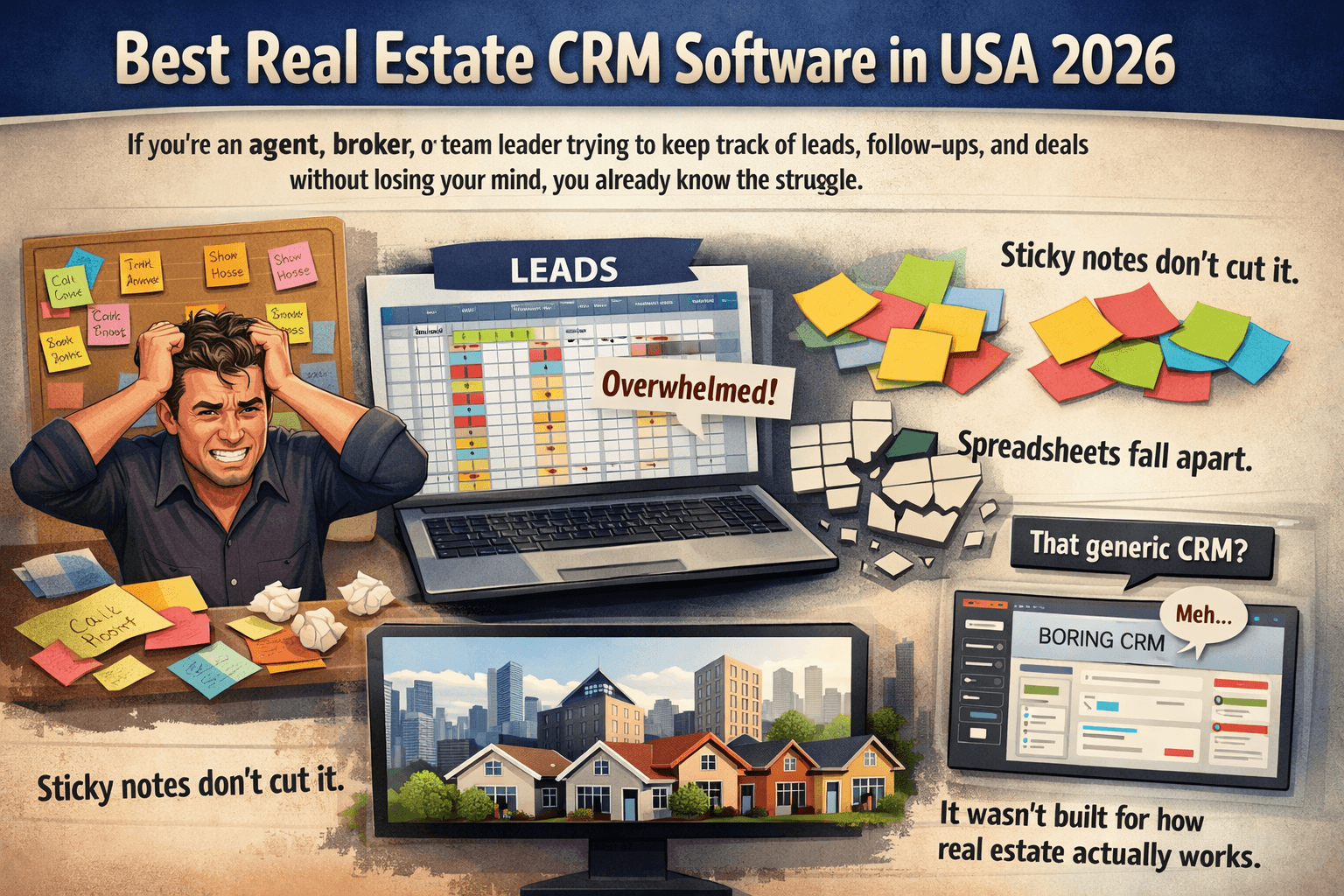
If you’re an agent, broker, or
team leader trying to keep track of leads, follow-ups, and deals without losing
your mind, you already know the struggle. Sticky notes don’t cut it.
Spreadsheets fall apart once you hit 50 contacts. And that generic CRM your
friend recommended? It wasn’t built for how real estate actually works.
That’s exactly why the real
estate CRM software market has exploded over the last few years. There are now
dozens of platforms promising to organize your pipeline, automate your
outreach, and help you close faster. But here’s the thing — not all of them deliver
on those promises.
I spent weeks digging into the
most popular CRM solutions used by US-based real estate professionals. I talked
to agents, read through forums, tested free trials, and compared pricing pages
until my eyes went blurry. This guide breaks down what I found — the good, the
bad, and everything in between — so you can make a decision that actually fits
your business.
What Is Real Estate CRM Software?
CRM stands for Customer
Relationship Management. In the real estate world, a CRM is a tool that helps
you manage every interaction you have with buyers, sellers, renters, and past
clients. Think of it as a central hub where all your contact data, conversation
history, property details, and task reminders live together.
A real estate-specific CRM goes
beyond what you’d find in a general-purpose tool like HubSpot or Zoho. It
includes features that make sense for the industry — things like MLS
integration, automated drip campaigns tailored to homebuyers, transaction management,
and lead routing for teams. Some even connect directly to your IDX website so
that every visitor who signs up gets funneled into your pipeline automatically.
If you’re still managing client
relationships through your email inbox and memory alone, you’re almost
certainly leaving money on the table. Most agents who switch to a proper CRM
report closing more deals within the first six months — not because the software
does the work for them, but because it makes it nearly impossible to forget a
follow-up.
Why Real Estate Professionals Need a CRM in 2026
The real estate market in 2026
is a different animal than it was even two years ago. Interest rates have
shifted buyer behavior. Inventory levels are constantly changing. And
competition among agents has never been tougher, especially in markets like Austin,
Phoenix, and the Carolinas.
A CRM isn’t just a nice-to-have
anymore. It’s the backbone of how top-producing agents operate. Here’s what a
solid CRM helps you do:
It keeps every lead in one
place. Whether someone filled out a form on your website, called from a Zillow
listing, or walked into an open house, their info goes into the system and
nothing slips through.
It automates the grunt work.
Follow-up emails, birthday messages, market update newsletters — these things
run on autopilot once you set them up. You stay top of mind without manually
sending 40 emails a day.
It gives you visibility into
your pipeline. You can see exactly how many leads you have at each stage, which
deals are about to close, and where your bottlenecks are. That kind of clarity
changes how you plan your week.
It helps teams work together.
If you’re running a brokerage or a team, a CRM makes it easy to assign leads,
track individual performance, and make sure no opportunity gets ignored.
Bottom line: the agents who are
growing right now are the ones who’ve built systems around their business. A
CRM is the foundation of that system.
Top 10 Real Estate CRM Solutions for Agents and Brokers
Here’s my breakdown of the
leading CRM platforms built for real estate professionals in the United States.
I’ve ranked them based on ease of use, feature depth, pricing, customer
support, and how well they fit different business sizes.
1. SMART ERP Suite
SMART ERP Suite stands out as a
comprehensive real estate software platform that goes well beyond basic CRM
functionality. It combines lead management, transaction tracking, accounting,
and marketing automation into one unified system. For agencies that are tired
of stitching together five different tools, this is a breath of fresh air.
What makes SMART ERP Suite
particularly appealing is its flexibility. Whether you’re a solo agent handling
20 transactions a year or a mid-size brokerage managing hundreds, the platform
scales without forcing you into an expensive enterprise plan. The built-in
reporting tools give you a clear picture of your sales pipeline, agent
productivity, and marketing ROI — all from one dashboard.
The platform also offers strong
integration capabilities with MLS systems, popular listing portals, and
third-party marketing tools. Their customer support team is US-based and
responsive, which matters more than most people realize until they’re stuck at
9 PM trying to fix a workflow.
Pricing is competitive, and
they offer a 30-day free trial so you can test drive the full platform before
committing.
2. Follow Up Boss
Follow Up Boss has carved out a
reputation as the go-to CRM for real estate teams. It’s fast, clean, and built
specifically around one thing: making sure you never miss a lead follow-up. The
platform pulls in leads from over 200 sources including Zillow, Realtor.com,
and your own website, then distributes them to your team based on rules you
set.
The action plans feature is a
standout. You can create multi-step sequences that combine calls, texts, and
emails, then assign them to specific lead types. The interface is refreshingly
simple compared to some of the more bloated options on this list.
Pricing starts around $69 per
user per month, which adds up for larger teams but delivers solid value given
the automation capabilities.
3. kvCORE (Inside Real Estate)
kvCORE is more than a CRM —
it’s an all-in-one platform that includes IDX websites, lead generation,
marketing automation, and transaction management. It’s a popular choice among
brokerages because it provides enterprise-level features at a price point that
doesn’t require a Fortune 500 budget.
The AI-powered lead scoring and
behavioral tracking are genuinely useful. The platform watches how leads
interact with your website and adjusts their priority score accordingly, so
your agents focus on the people most likely to convert. The smart campaigns
feature sends targeted messages based on lead activity without you lifting a
finger.
4. LionDesk
LionDesk is one of the more
affordable real estate CRM options, starting at around $25 per month. Despite
the lower price tag, it punches above its weight with video email and texting
capabilities, drip campaigns, and lead management tools that cover the basics
well.
It’s a solid pick for solo
agents or small teams who need a CRM that’s straightforward and doesn’t require
a PhD to set up. The learning curve is gentle, and most users report being
fully operational within a day or two.
5. Wise Agent
Wise Agent has been around
since 2002, making it one of the veterans in the real estate CRM space. It
offers contact management, transaction tracking, and marketing tools at a flat
monthly rate with no per-user fees — which is a huge selling point for teams.
The platform includes a
built-in landing page builder, time management tools, and integration with over
100 lead sources. It’s not the flashiest option, but it’s reliable and
well-supported.
6. Real Geeks
Real Geeks combines IDX
websites with a built-in CRM, making it a popular choice for agents who want
lead generation and lead management under one roof. The Facebook marketing
integration is particularly strong, allowing you to run targeted ads and capture
leads directly into the CRM.
The CRM itself includes
property alerts, automated workflows, and SMS capabilities. It’s a well-rounded
platform, though the website designs can feel a bit template-heavy compared to
custom solutions.
7. Salesforce (with Real Estate Add-ons)
Salesforce is the heavyweight
champion of CRM software across all industries. For real estate, it works best
when paired with industry-specific add-ons from the Salesforce AppExchange. The
customization possibilities are virtually unlimited, which is both its greatest
strength and its biggest drawback.
This is not a plug-and-play
solution. You’ll likely need a consultant or admin to set it up properly. But
for large brokerages or commercial real estate firms that need deep reporting,
complex workflows, and integration with virtually any third-party tool,
Salesforce is hard to beat.
8. CINC (Commissions Inc.)
CINC focuses heavily on lead
generation and conversion, combining a CRM with paid advertising management.
They run Google and Facebook ads on your behalf and funnel leads directly into
their CRM, where automated nurture sequences take over.
The platform works best for
teams and agents who are serious about paid lead generation and want a turnkey
solution. Pricing is on the higher end, typically starting around $900 per
month for smaller teams, but the lead volume can justify the cost for the right
business.
9. Propertybase
Propertybase is built on the
Salesforce framework, giving it enterprise-grade power with a real
estate-specific interface. It’s designed for brokerages and luxury real estate
firms that need polished branding, IDX integration, and robust reporting.
The back-office features are
strong, with commission tracking, compliance tools, and team management built
in. It’s overkill for solo agents, but for established brokerages, it checks a
lot of boxes.
10. Chime
Chime rounds out this list with
an AI-powered CRM that includes IDX websites, digital advertising, and team
management tools. The AI assistant can respond to leads via text automatically,
qualify prospects, and schedule appointments — which is a game changer for busy
agents who can’t respond to every inquiry within five minutes.
Chime’s pricing is mid-range,
and the platform offers a good balance of automation and control. The
onboarding process includes personalized training, which helps teams get up to
speed quickly.
How to Choose the Right Real Estate CRM for Your Business
With so many options on the
market, picking the right CRM can feel overwhelming. Here’s a practical
framework to narrow things down.
Start with your business size.
Solo agents and small teams usually don’t need enterprise-level platforms.
Something like LionDesk, Wise Agent, or SMART ERP Suite will cover your needs
without burning a hole in your budget. If you’re running a brokerage with
20-plus agents, look at platforms that offer lead routing, team performance
dashboards, and scalable pricing.
Think about what you’re already
using. If your website runs on a specific IDX platform, make sure your CRM
integrates with it. If you rely heavily on Zillow or Realtor.com for leads,
check whether the CRM can pull those in automatically. The less manual data
entry you have to do, the more likely you’ll actually use the system
consistently.
Don’t overvalue features you
won’t use. A CRM with 200 features sounds impressive until you realize you’re
only using three of them. Focus on the workflows that matter most to your
business — lead follow-up, pipeline visibility, and communication automation —
and choose the platform that does those things best.
Always test before you buy.
Most CRMs on this list offer free trials or demos. Take advantage of that.
Import some real contacts, set up a few automations, and see how it feels in
your daily routine. The best CRM is the one you’ll actually use every day.
Key Features Every Real Estate CRM Should Have
Not all CRMs are created equal.
Some focus on lead generation, others on transaction management, and a few try
to do everything. Regardless of which platform you choose, there are certain
features that should be non-negotiable.
Lead capture and distribution
is table stakes. Your CRM should pull leads from multiple sources — your
website, social media ads, listing portals, and referral networks — and route
them to the right person on your team within minutes, not hours.
Automated follow-up sequences
are where the real value lives. The average real estate lead needs 8 to 12
touchpoints before they’re ready to work with an agent. If you’re doing all of
that manually, you’re either spending your entire day on follow-ups or letting
leads go cold. A good CRM handles this for you with drip campaigns, text
sequences, and scheduled calls.
Mobile access is essential.
Real estate doesn’t happen behind a desk. You need a CRM with a mobile app that
lets you update contact records, log calls, and respond to leads while you’re
between showings. If the mobile experience feels like an afterthought, that’s a
red flag.
Reporting and analytics round
out the must-haves. You should be able to see how many leads came in this
month, what your conversion rate looks like, and which marketing channels are
actually producing results. Data-driven decisions separate growing businesses
from stagnant ones.
Real Estate CRM vs. General CRM: What’s the Difference?
You might be wondering whether
a general-purpose CRM like HubSpot, Zoho, or Monday.com could work for your
real estate business. Technically, it can. Practically, it usually creates more
headaches than it solves.
General CRMs are built for a
wide range of industries. They handle contacts, deals, and tasks, but they
don’t understand real estate-specific workflows out of the box. You won’t find
MLS integration, property matching, or transaction timelines without significant
customization.
Real estate CRMs, on the other
hand, are designed with the agent’s daily workflow in mind. They know that a
“lead” in real estate often means someone who’s browsing listings on your IDX
site at midnight. They know that deals have inspection dates, appraisal
deadlines, and closing timelines that need tracking. They know that your
marketing needs to include property-specific content, not generic newsletters.
That said, if you’re running a
commercial real estate business or a real estate investment firm, the overlap
between general and industry-specific CRMs gets blurrier. Platforms like
Salesforce with real estate add-ons or SMART ERP Suite that blend ERP functionality
with CRM features can serve both worlds effectively.
Real Estate CRM Pricing Comparison: What to Expect in 2026
Pricing for real estate CRM
software varies wildly depending on the platform, the number of users, and the
features you need. Here’s a rough breakdown of what you can expect to pay:
Budget-friendly options like
LionDesk and Wise Agent typically run between $25 and $50 per month. They cover
the basics well and are ideal for solo agents or agents just getting started
with CRM systems.
Mid-range platforms such as
Follow Up Boss, Real Geeks, and Chime usually cost between $69 and $300 per
month depending on team size and feature tier. These offer more robust
automation, lead generation tools, and team management features.
Enterprise-level solutions like
CINC, Propertybase, and customized Salesforce setups can range from $500 to
well over $1,500 per month. These make sense for large brokerages and firms
that need advanced reporting, compliance tools, and high-volume lead management.
SMART ERP Suite positions
itself in the mid-range while offering feature depth that competes with
enterprise platforms. Its all-in-one approach means you’re not paying
separately for a CRM, accounting software, and marketing tools, which can
result in significant savings over time.
When comparing pricing, always
look at the total cost of ownership. A CRM that costs $30 per month but
requires a $200 per month add-on for email automation isn’t actually cheaper
than a $150 per month platform that includes everything.
Final Thoughts: Picking the Right CRM Matters More Than You Think
Here’s the honest truth about
choosing a real estate CRM: there is no single “best” option for everyone. The
right platform depends on your business size, your budget, how tech-savvy you
are, and what you actually need the software to do day-to-day.
What I can tell you is that
doing nothing is the worst option. Every day you spend managing leads in a
spreadsheet or relying on memory to schedule follow-ups is a day you’re leaving
deals on the table. The real estate professionals who are thriving in 2026 have
systems in place, and a solid CRM is at the center of those systems.
If you’re looking for a
platform that balances power, usability, and value, SMART ERP Suite is worth
serious consideration. It handles CRM, accounting, and marketing under one
roof, which eliminates the headache of managing multiple subscriptions and integrations.
And with a free trial available, there’s no reason not to give it a shot.
Whatever you choose, commit to
it. Import your contacts, set up your automations, and give it at least 60 days
before judging the results. A CRM only works if you work it.