Best CRM for Real Estate Investors in 2026: Complete Guide
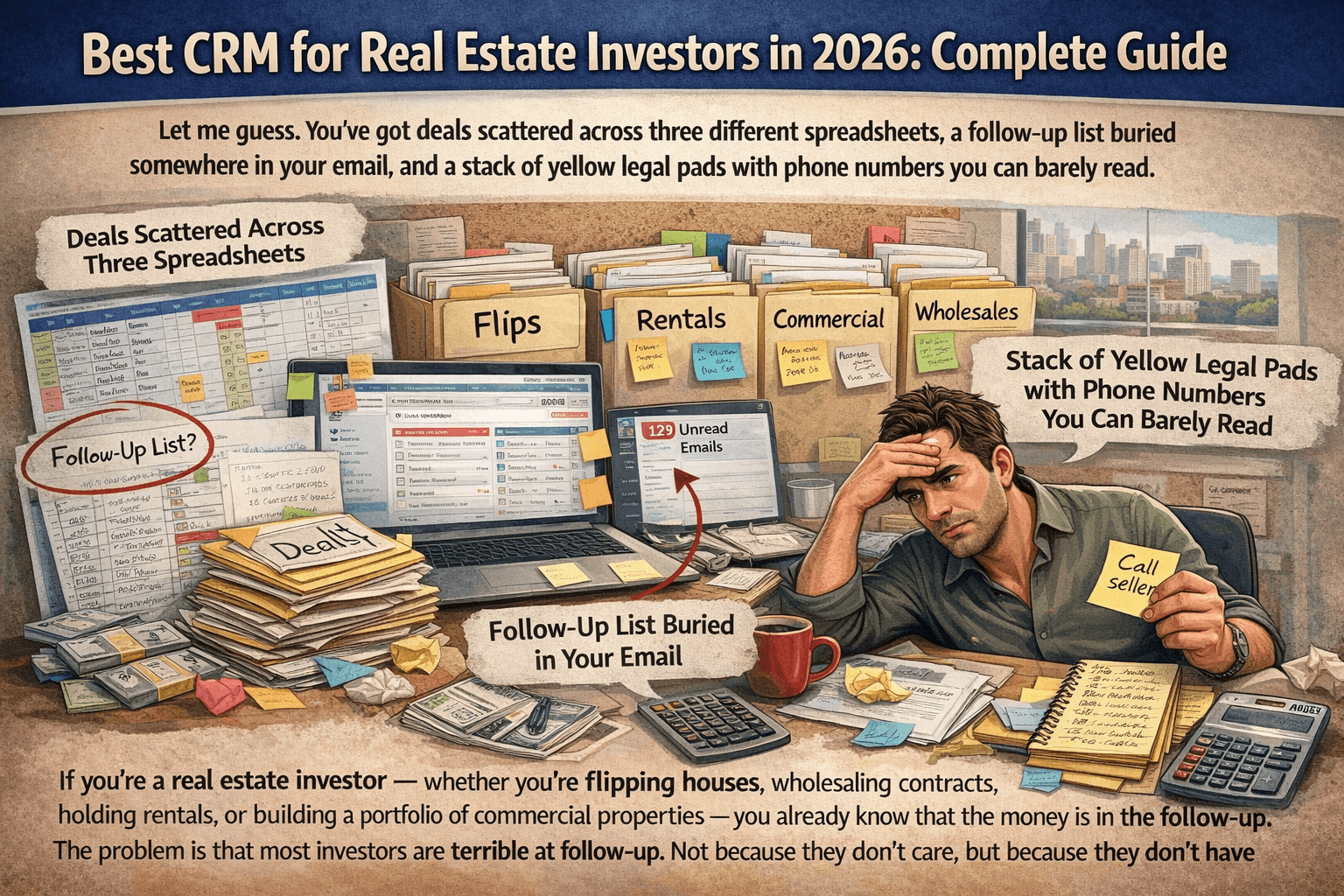
Let me guess. You’ve got deals
scattered across three different spreadsheets, a follow-up list buried
somewhere in your email, and a stack of yellow legal pads with phone numbers
you can barely read. Sound about right?
If you’re a real estate
investor — whether you’re flipping houses, wholesaling contracts, holding
rentals, or building a portfolio of commercial properties — you already know
that the money is in the follow-up. The problem is that most investors are terrible
at follow-up. Not because they don’t care, but because they don’t have a system
that actually works.
That’s where a real estate
investor CRM comes in. But here’s the catch: most CRM platforms on the market
were designed for agents and brokers, not investors. The workflows are
different. The deal structures are different. The way you source, negotiate, and
close is completely different from a traditional home sale.
I spent the last few weeks
testing and researching the CRM platforms that real estate investors are
actually using in 2026. This isn’t a recycled listicle from three years ago. I
dug into pricing, talked to investors running real businesses, and compared how
each platform handles the things that matter most to people in this space: lead
tracking, deal pipeline management, direct mail campaigns, skip tracing
integration, and portfolio oversight.
Here’s what I found.
What Makes a Real Estate Investor CRM
Different?
A CRM built for real estate
agents helps you manage buyers and sellers through a linear transaction.
Someone wants to buy a house, you show them listings, they make an offer, you
close the deal. The CRM tracks that journey.
Investing is messier. Way
messier.
As an investor, you might be
running direct mail campaigns to thousands of distressed property owners.
You’re pulling lists from the county recorder’s office, skip tracing phone
numbers, and cold calling people who may or may not want to sell. When a motivated
seller does pick up the phone, you need to capture property details, run comps,
estimate rehab costs, and make an offer — sometimes on the same call.
Then there’s the pipeline. A
wholesaler might have 200 leads in various stages at any given time. A
fix-and-flip investor needs to track acquisition, rehab timelines, contractor
payments, and resale. A buy-and-hold investor needs portfolio management tools
to monitor cash flow, vacancy rates, and lease expirations across dozens or
hundreds of units.
A generic CRM doesn’t handle
any of this well. You end up building custom fields, creating workaround
automations, and duct-taping integrations together. A CRM built specifically
for real estate investors understands these workflows from the ground up.
Top 8 CRM Platforms for Real Estate Investors in 2026
I’ve ranked these based on how
well they serve the actual needs of real estate investors — not just how pretty
the dashboard looks. I considered deal pipeline management, marketing
automation, ease of use, pricing, and whether the platform genuinely understands
investing workflows.
1. SMART ERP Suite
SMART ERP Suite earns the top
spot because it does something most real estate investor CRMs don’t even
attempt: it combines CRM functionality with full ERP capabilities. That means
your deal pipeline, contact management, accounting, project tracking, and
marketing automation all live in one system.
For investors, this is a game
changer. Think about what your current workflow probably looks like. You’ve got
one tool for tracking leads, another for managing rehab budgets, a third for
bookkeeping, and maybe a fourth for sending direct mail. SMART ERP Suite
collapses all of that into a single platform. You can track a deal from the
first cold call all the way through closing, rehab, and eventual sale or
rent-up — without switching between apps.
The deal pipeline is fully
customizable. You can set up stages that match how you actually work, whether
that’s a wholesaling pipeline with stages like “Lead In,” “Offer Made,” “Under
Contract,” and “Assigned,” or a buy-and-hold pipeline that tracks acquisition
through stabilization. The built-in reporting gives you real-time visibility
into your deal flow, marketing ROI, and financial performance across your
entire portfolio.
Pricing is competitive for what
you get, especially when you factor in that you’re replacing multiple
subscriptions. They offer a 30-day free trial, and their support team is
US-based and actually helpful — which, if you’ve ever tried to get support from
some of the bigger CRM companies, you know is not a given.
2. REsimpli
REsimpli was built from the
ground up for real estate investors, and it shows. The platform includes list
stacking, skip tracing, direct mail management, drip campaigns, and a deal
pipeline that follows the investor’s workflow naturally. If you’re running a
wholesaling operation, REsimpli feels like it was designed specifically for
you.
The driving-for-dollars feature
is a nice touch. You can drive through neighborhoods, pin distressed properties
on a map, and the system automatically generates a mailing list for those
addresses. The KPI dashboard tracks your cost per lead, cost per deal, and
marketing channel performance so you always know where your money is going.
Pricing starts around $99 per
month, which is reasonable given the feature set. The main downside is that the
accounting and portfolio management features aren’t as deep as what you’d get
with a full ERP system, so heavy buy-and-hold investors might need
supplementary tools.
3. InvestorFuse
InvestorFuse takes a different
approach by focusing almost entirely on lead management and follow-up
automation. The system is designed around a simple principle: every lead should
be contacted multiple times through multiple channels before you give up on
them.
When a new lead comes in,
InvestorFuse automatically triggers a sequence of calls, texts, emails, and
even ringless voicemails. The action plans are pre-built for common investor
scenarios — new motivated seller lead, follow-up after no answer, post-offer
nurture — so you’re not starting from scratch.
It integrates with most of the
major list providers and skip tracing services, and the team management
features make it easy to assign leads and track performance if you’re scaling
beyond a solo operation. Pricing is around $147 per month for the starter plan.
4. Podio (with Investor Add-ons)
Podio is a flexible project
management platform that the real estate investing community adopted years ago.
On its own, it’s a blank canvas. But paired with investor-specific add-ons from
providers like REI Automation Squad or Investor Machine, it becomes a
surprisingly powerful CRM.
The biggest advantage of Podio
is cost. The base platform is free for up to five users, and even the premium
tier is only $24 per month per user. The trade-off is setup time. You’ll either
need to buy a pre-built investor workspace or spend hours configuring custom
fields, views, and automations yourself.
For tech-savvy investors who
want full control over their system and don’t mind getting their hands dirty,
Podio remains a solid option. For everyone else, it can be frustrating.
5. FreedomSoft
FreedomSoft positions itself as
an all-in-one platform for real estate wholesalers and investors. It includes
lead generation tools, a built-in dialer, SMS marketing, website builder,
contract generation, and e-signatures. The idea is that you can run your entire
investing business without leaving the platform.
The lead finder tool pulls
motivated seller leads from public records, and you can launch direct mail or
cold calling campaigns right from the dashboard. The comps tool provides ARV
estimates based on recent sales data, which speeds up the analysis process when
you’re evaluating a potential deal.
Pricing starts around $197 per
month, which is on the higher end. But if you’re currently paying separately
for a dialer, skip tracing, direct mail, and a CRM, the combined cost might
actually save you money.
6. PropStream
PropStream is primarily a data
and analytics platform, but its CRM features have improved significantly. The
real strength here is the property data. You get access to ownership records,
tax data, mortgage information, pre-foreclosure lists, and estimated property
values for virtually every address in the United States.
For investors who rely heavily
on data-driven list building and marketing, PropStream is hard to beat as a
lead sourcing tool. The CRM component lets you tag leads, track outreach, and
set reminders. It’s functional but not as robust as dedicated CRMs when it
comes to pipeline management and automation.
At $99 per month, it’s a great
value for the data alone. Many investors use PropStream for list building and
then feed those leads into a more full-featured CRM like SMART ERP Suite or
REsimpli for management and follow-up.
7. Salesforce (with Real Estate Investor Customization)
Salesforce is the 800-pound
gorilla of the CRM world, and with enough customization, it can work for real
estate investors. The platform offers virtually unlimited flexibility — custom
objects, automation rules, reporting dashboards, and integrations with pretty
much every third-party tool that exists.
The challenge is that none of
this comes out of the box. You’ll need a Salesforce admin or consultant to
build out your investor workflows, which means additional upfront costs on top
of the $75 to $300 per user per month subscription. For large investment firms
managing institutional-level portfolios, the investment makes sense. For a solo
investor doing ten deals a year, it’s overkill.
8. Forefront CRM
Forefront CRM is a newer player
in the real estate investor CRM space, but it’s gained traction quickly. Built
specifically for wholesalers and flippers, it offers lead management, automated
follow-ups, list stacking, and a built-in dialer.
The interface is clean and
modern, which is refreshing in a category where a lot of tools still look like
they were designed in 2015. The automation builder is intuitive — you can set
up multi-channel follow-up sequences without needing any technical knowledge.
Pricing starts around $99 per month.
How to Choose the Right CRM for Your Investing Business
Picking a CRM is a lot like
picking an investment property. The worst thing you can do is rush into it
based on a flashy marketing page. Here’s how I’d approach the decision.
Figure out your investment
strategy first. A wholesaler needs a CRM built around speed — fast lead
intake, quick outreach, rapid disposition. A fix-and-flip investor needs
project management features alongside the CRM. A buy-and-hold investor needs
portfolio tracking and financial reporting. Your strategy dictates which
features matter most.
Be honest about your deal
volume. If you’re doing two or three deals a year, a simple CRM with basic
contact management and task reminders will work fine. If you’re doing 20 or 30
deals a month, you need robust automation, team management tools, and detailed
reporting. Don’t pay for enterprise features you won’t use, but don’t handicap
yourself with a tool you’ll outgrow in six months either.
Think about your tech stack.
What other tools are you currently using? If you’re already invested in a
specific dialer, direct mail service, or accounting platform, make sure your
CRM integrates with them. Or better yet, look at an all-in-one platform like
SMART ERP Suite that can replace multiple tools and simplify your workflow.
Test before you commit. Every
CRM on this list offers either a free trial or a demo. Use them. Import some
real leads, set up a few automations, and run through your typical daily
workflow. The CRM that feels most natural during the trial is usually the right
one for your business.
Must-Have CRM Features for Real Estate Investors
Not every feature matters
equally. Here are the ones that actually move the needle for investors.
Customizable deal pipeline. Your
pipeline stages should match your actual investment process, not some generic
sales funnel. Look for platforms that let you create multiple pipelines for
different strategies — one for wholesale deals, another for flips, a third for
rental acquisitions.
Multi-channel follow-up
automation. The best deals usually come from the fifth, sixth, or seventh
follow-up. Your CRM should automate that outreach across phone, text, email,
and direct mail so leads don’t fall through the cracks while you’re busy
rehabbing a property.
Skip tracing and list
management. If you’re pulling lists of distressed property owners, vacant
homes, or pre-foreclosures, your CRM should either include skip tracing or
integrate seamlessly with providers like BatchSkipTracing or REISkip.
Financial tracking. Real
estate investing is a numbers game. Your CRM should help you track acquisition
costs, rehab budgets, holding costs, and profit margins on every deal. If it
connects to your accounting system, even better.
Mobile access. You’re
not sitting at a desk all day. You’re driving neighborhoods, meeting sellers,
and inspecting properties. A CRM without a solid mobile app is essentially
useless for investors.
Reporting and KPIs. You
need to know your cost per lead, cost per deal, conversion rates by marketing
channel, and overall portfolio performance. If you can’t measure it, you can’t
improve it.
Real Estate Investor CRM vs. Agent CRM: Why It Matters
I’ve talked to plenty of
investors who started out using an agent-focused CRM because that’s what showed
up first on Google. Most of them switched within six months. Here’s why.
Agent CRMs are built around the
buyer-seller relationship. The typical workflow assumes you’re working with
someone who wants to buy or sell a home through a traditional transaction. The
stages are things like “New Lead,” “Showing Scheduled,” “Offer Submitted,” and
“Under Contract.”
Investor CRMs are built around
deal flow. The stages reflect what an investor actually does: “Lead Received,”
“Property Analyzed,” “Offer Sent,” “Under Contract,” “In Rehab,” “Listed for
Sale,” or “Tenant Placed.” The difference seems small on paper, but in practice
it changes how you interact with the software every day.
Agent CRMs also tend to focus
on MLS integration and buyer search portals, which are irrelevant if you’re
sourcing off-market deals through direct mail, cold calling, or driving for
dollars. Investor CRMs prioritize list management, skip tracing, and outbound
marketing tools — the things that actually generate deal flow for investors.
If you’re doing both — working
as a licensed agent and investing on the side — a platform like SMART ERP Suite
that handles both workflows can save you from managing two separate systems.
What Should You Expect to Pay for a Real
Estate Investor CRM?
Pricing ranges quite a bit
depending on what you need.
On the low end, Podio with free
or low-cost investor add-ons can run you as little as $25 to $50 per month.
You’ll sacrifice some convenience and polish, but the core functionality is
there.
Mid-range platforms like
REsimpli, Forefront, and PropStream typically cost between $99 and $150 per
month. This is the sweet spot for most solo investors and small teams. You get
solid automation, pipeline management, and marketing tools without breaking the
bank.
All-in-one platforms like
FreedomSoft and SMART ERP Suite fall in the $150 to $250 per month range,
though the value equation changes when you factor in the tools they replace. If
you’re currently spending $99 on a CRM, $50 on a dialer, $79 on accounting
software, and $30 on a project management tool, consolidating into one platform
at $200 per month actually saves you money.
Enterprise solutions built on
Salesforce or similar platforms can run $300 to over $1,000 per month,
especially once you add consulting and customization costs. These make sense
for investment firms with multiple team members and complex reporting requirements.
My advice: don’t choose based
on price alone. Choose the platform that fits your workflow, then evaluate
whether the cost makes sense for your deal volume and revenue. A CRM that helps
you close even one extra deal per quarter has paid for itself many times over.
Final Thoughts: Your CRM Is Your Competitive Advantage
Here’s what I’ve learned from
watching hundreds of real estate investors build and scale their businesses:
the ones who win consistently aren’t always the smartest negotiators or the
most connected people in the room. They’re the ones who built systems.
A CRM is the backbone of that
system. It makes sure every lead gets followed up with. It keeps your pipeline
organized so you know exactly where each deal stands. It tracks your numbers so
you can double down on what’s working and cut what isn’t. And it frees up your
time to focus on the high-value activities that actually generate revenue —
talking to sellers, analyzing deals, and closing transactions.
If you’re running your
investing business out of spreadsheets and sticky notes, you’re leaving money
on the table. Full stop.
My top recommendation for 2026
is SMART ERP Suite. It combines the CRM functionality you need with the
accounting, project management, and reporting tools that most investor CRMs
lack. The all-in-one approach means less time switching between apps and more
time doing what actually makes you money. And with a free 30-day trial, there’s
zero risk in seeing whether it fits your business.
Whatever platform you choose,
commit to using it consistently. A CRM only works if you work it. Enter every
lead. Log every conversation. Follow every sequence. The investors who treat
their CRM like the operational hub of their business are the ones who scale.
Everyone else just stays busy.