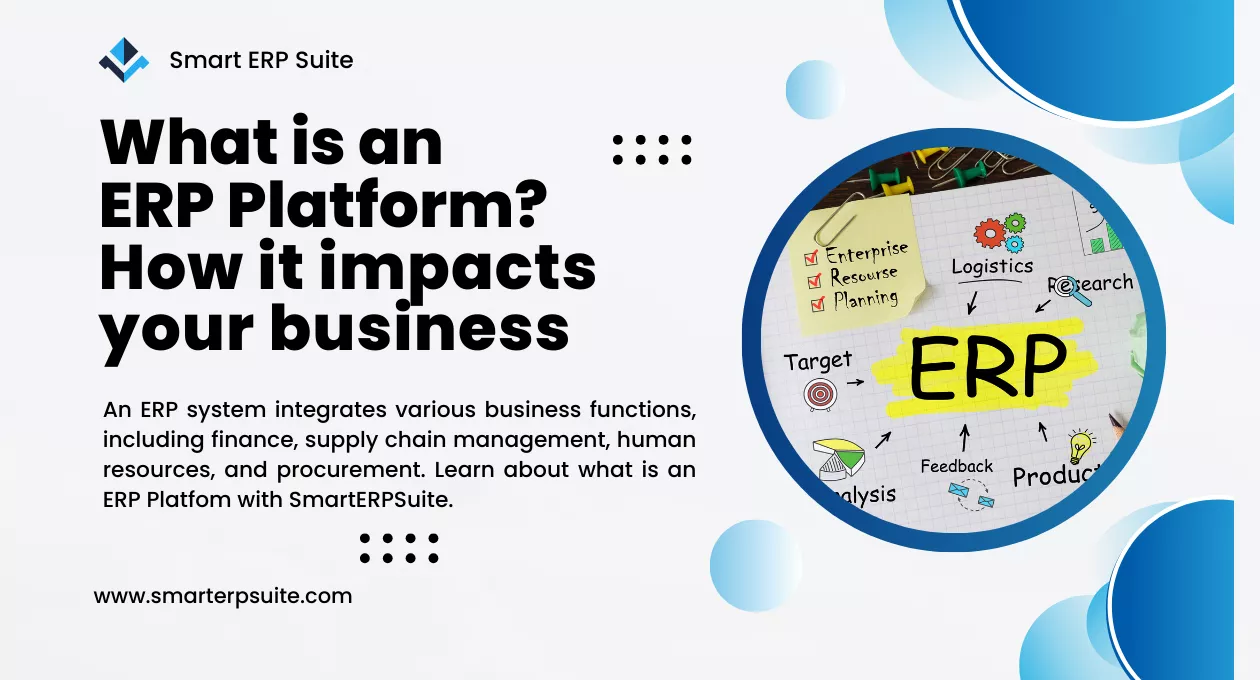
In today’s fast-moving business world, understanding what is an ERP platform and how it impacts your business is critical. Companies in the USA and around the world are adopting ERP software to simplify complex operations, manage supply chain operations, and achieve digital transformation. An ERP system provides a centralized hub for all business processes, offering real-time business insights that guide better decisions. From financial management software to human resources management, an ERP platform connects every part of a business, reducing errors and improving efficiency.
Modern companies face growing pressure to integrate technology, ensure data integrity, and provide real-time reporting in ERP. Without an ERP system, businesses rely on scattered tools, causing miscommunication, delays, and lost opportunities. A robust ERP platform is no longer a luxury; it is a core investment for operational success. SmartERPSuite helps companies, both large and small, achieve a single source of truth across departments, making workflow smoother and more effective.
Enterprise resource planning—Overview
Enterprise resource planning combines technology and strategy to manage all essential business processes. An ERP system integrates accounting software, inventory management, project management software, procurement management, and more. It creates a unified environment where information flows freely, enabling ERP integration with CRM systems and seamless collaboration. By connecting all departments, businesses can ensure that real-time business insights are available to executives and managers at every level.
With ERP software, businesses improve workflow automation and reduce manual errors. Traditional processes in finance, HR, and operations can now be managed in a single platform, improving ERP data centralization and analytics. Companies using Cloud ERP or on-premises ERP can monitor operations from anywhere, make faster decisions, and scale easily. The integration of Artificial intelligence in ERP and Machine learning ERP technologies allows companies to predict trends, optimize resources, and enhance productivity.
Definition of enterprise resource planning (ERP)
Enterprise resource planning (ERP) is a system that unifies all business processes into one platform. It connects financial management software, human resources management, supply chain operations, and more. By centralizing data, ERP ensures data integrity and a single source of truth for decision-making. Businesses no longer need to rely on disconnected spreadsheets or outdated legacy ERP systems.
ERP supports business process management, enabling leaders to monitor performance, streamline operations, and reduce costs. Modern ERP platforms offer workflow automation, real-time reporting in ERP, and analytics to track company performance. ERP for small and medium-sized businesses is no longer restricted to large corporations. Affordable SaaS ERP and Cloud ERP solutions allow organizations of all sizes to implement advanced digital systems quickly.
What is an ERP system?
An ERP system is software designed to manage and integrate core business activities. It can handle inventory management, accounting software, project management software, procurement management, and human resources management in a single platform. Companies using an ERP system benefit from real-time business insights and improved ERP data centralization and analytics.
Modern ERP modules for finance, HR, and operations allow businesses to automate repetitive tasks, ensure data integrity, and provide a unified workflow. ERP software to reduce operational costs helps organizations minimize errors, eliminate redundancies, and speed up decision-making. With ERP system for production and distribution, companies can track orders, shipments, and inventory levels efficiently, achieving digital transformation across operations.
What’s the difference between ERP and financials?
Many businesses confuse ERP vs financial management software, but they are different. Financial software only focuses on accounting, reporting, and budgeting. An ERP system, on the other hand, integrates financial management software, supply chain operations, human resources management, and more, offering a complete view of business performance.
For example, while accounting software records transactions, an ERP system ensures that every sale, shipment, and expense updates all departments automatically. Companies gain real-time reporting in ERP, better workflow automation, and full ERP integration with CRM systems. This makes ERP essential for businesses aiming for efficiency, accuracy, and growth in the modern digital landscape.
ERP fundamentals
At its core, an ERP system is built around ERP modules for finance, HR, and operations, workflow automation, and enterprise performance management (EPM). These systems are designed for ERP data centralization and analytics, enabling managers to monitor key metrics across departments in real-time. Inventory management, procurement management, and project management software are all integrated to simplify complex business operations.

ERP deployment models include on-premises ERP, Cloud ERP, and SaaS ERP solutions. Each model has unique advantages. On-premises ERP offers full control and security, while cloud-based systems allow mobility, remote access, and easy updates. The integration of Internet of Things (IoT) ERP and Blockchain ERP technologies adds another layer of efficiency, tracking, and transparency in operations.
Trending in modern finance
Modern finance is moving fast. Companies in the USA are embracing Cloud ERP for mobile and remote workforce and next-generation ERP technologies like Artificial intelligence in ERP and Machine learning ERP. These tools provide real-time business insights for better forecasting, budgeting, and risk management.
Financial departments benefit from ERP software to reduce operational costs, automate workflow efficiency, and ensure ERP data centralization and analytics. Digital tools also integrate ERP modules for finance, HR, and operations to streamline approvals, manage payroll, and handle expenses accurately. With ERP cloud migration, businesses reduce infrastructure costs while improving agility and reporting speed.
The business value of ERP
The business value of ERP lies in its ability to unify processes and provide a single source of truth. Companies can optimize supply chain operations, inventory management, procurement management, and more. This leads to reduced errors, faster decision-making, and higher productivity. By using ERP software, businesses gain real-time business insights, enabling executives to respond quickly to market changes.
ERP enhances digital transformation efforts by supporting Enterprise performance management (EPM) and workflow automation. Businesses also experience improved collaboration between departments, simplified compliance with regulations, and reduced operational costs. Cloud ERP solutions further allow teams to work remotely without sacrificing data integrity or operational control.
A brief history of ERP
The origins of ERP trace back to Manufacturing resource planning (MRP / MRP II) systems in the 1960s. These systems were initially designed to manage manufacturing processes, inventory, and scheduling. Over time, ERP evolved into legacy ERP systems that integrated financial management software and human resources management across entire organizations.
In the 1990s, client-server ERP solutions expanded capabilities to include procurement management, project management software, and accounting software. The 2000s saw the rise of SaaS ERP and Cloud ERP, enabling ERP cloud migration and mobile accessibility. Today, next-generation ERP technologies such as Artificial intelligence in ERP, Machine learning ERP, Internet of Things (IoT) ERP, and Blockchain ERP are shaping modern ERP for digital business.
ERP deployment models: From on-premises to the cloud
ERP deployment has evolved from traditional on-premises ERP to modern Cloud ERP solutions. On-premises ERP offers full control over data and customization but requires significant IT infrastructure and maintenance. In contrast, Cloud ERP provides scalability, remote access, and automatic updates without heavy upfront costs.
Many companies now adopt hybrid models, combining legacy ERP systems with cloud solutions to gradually modernize operations. ERP cloud migration ensures that businesses can manage supply chain operations, human resources management, and financial management software from a unified, centralized platform. This approach enhances flexibility, efficiency, and workflow automation while reducing IT burdens.
Cloud ERP—A new ERP delivery model
Cloud ERP has transformed how businesses operate. It allows real-time monitoring of inventory management, procurement management, and project management software from anywhere in the world. Companies can adopt ERP software to reduce operational costs while maintaining secure, centralized data storage.
Cloud platforms also enable ERP integration with CRM systems, creating seamless connections between sales, marketing, and operations. Mobile teams benefit from Cloud ERP for mobile and remote workforce, gaining access to real-time business insights anytime. Businesses can scale operations quickly, adopt next-generation ERP technologies, and achieve digital transformation without disrupting existing processes.
7 reasons to move to an ERP cloud solution
The benefits of moving to a Cloud ERP solution are clear. First, businesses gain real-time reporting in ERP, enabling faster decision-making. Second, workflow automation reduces manual work and errors. Third, teams experience enhanced collaboration through a single source of truth. Fourth, costs associated with IT infrastructure drop significantly.
Fifth, ERP software to reduce operational costs improves profitability. Sixth, integration with ERP modules for finance, HR, and operations ensures seamless operations. Finally, companies adopting cloud platforms can leverage next-generation ERP technologies like Artificial intelligence in ERP and Machine learning ERP to stay competitive. These advantages make ERP for small and medium-sized businesses more accessible than ever.
Table: ERP Deployment Comparison
Frequently Asked Questions (FAQ)
Q1: Why is an ERP platform important for business?
An ERP platform integrates all business processes, providing real-time business insights and a single source of truth, which improves efficiency and decision-making. It helps reduce errors and streamline operations across departments.
Q2: What are the main components of an ERP system?
An ERP system includes financial management software, human resources management, supply chain operations, inventory management, and workflow automation, all connected to provide centralized data. These components ensure smooth daily operations.
Q3: How does Cloud ERP differ from on-premises ERP?
Cloud ERP allows access from anywhere, supports mobile and remote workforce, and updates automatically, while on-premises ERP requires local servers and manual maintenance. Cloud solutions are scalable and cost-effective.
Q4: Can small businesses benefit from ERP systems?
Yes, ERP for small and medium-sized businesses helps streamline procurement management, project management software, and financial management software without heavy IT investment, enabling growth and efficiency.
Q5: What challenges can occur during ERP implementation?
Common ERP implementation challenges include legacy ERP systems, data migration issues, and user adoption difficulties, but careful planning, training, and expert guidance can ensure a smooth deployment.
Conclusion
A mid-sized US manufacturing company implemented SmartERPSuite Cloud ERP. Within six months, workflow efficiency improved, inventory management errors dropped by 40%, and real-time reporting in ERP allowed executives to optimize production. The company also integrated ERP modules for finance, HR, and operations, demonstrating how modern ERP for digital business transforms everyday operations.